
To keep things interesting, we invite you to take a look at the Tradeel review, where we examine yet another Forex/CFD broker promising access to 4,000+ global market instruments and services from a supposedly licensed company. Everything is here, just as expected: claims of lightning-fast withdrawals, exclusive support, and a next-generation trading platform. We would certainly like to believe these statements, but something suggests that the only thing truly perfected here is the ability to appropriate traders’ funds. We set out to find evidence that this project is fraudulent, and present our findings below.
Tradeel Quick Card
| Investigation Date | 28/04/2026 |
| Update | 10/09/2026 |
| Active Website | https://tradeel.com/ |
| Domain Age | Since 25/06/2025 |
| Brand Name | Tradeel |
| Operating Entity | Tradeel LTD |
| Stated Jurisdiction | Mwali (Moheli), Comoros Union |
| Blacklist Status | Not found |
| License Status | Verified |
| License Number | MISA BFX2025129 |
| Office Address | Bonovo Road, Fomboni, Island of Mohéli, Union of the Comoros |
| Phone Number | +44 7458 164441 |
| Support Email | contact@tradeel.support |
| Quick Contacts | Live chat |
| Company Activities | Brokerage |
| Investing Terms | $100 |
| Risk Assessment | High risk |
Let’s Identify the Company’s Background
We never tire of emphasizing that choosing the right trading platform is one of the most important tasks for any trader who wants to trade profitably and not worry about the safety of their funds. That is why a thorough analysis of a broker’s official information — its registration, licensing, operating history, etc. — is essential. Only based on such data can one draw a reasoned conclusion about whether a company is legitimate or a fraudulent project. Tradeel is no exception, and our review began with examining the information provided on its website.
Tradeel Jurisdiction and Regulation
First of all, we look for details about the company’s official registration and licensing. It should be noted that the broker does not hide this information and has published:
- The company name under which it operates — Tradeel LTD.
- Registration details in the autonomous island of Mwali (Moheli), Comoros Union, including registration number HT01025104.
- Information about holding a brokerage license No. BFX2025129, issued by the local financial regulator, Mwali International Services Authority (MISA).
All that remains is to verify these claims by checking open registries.
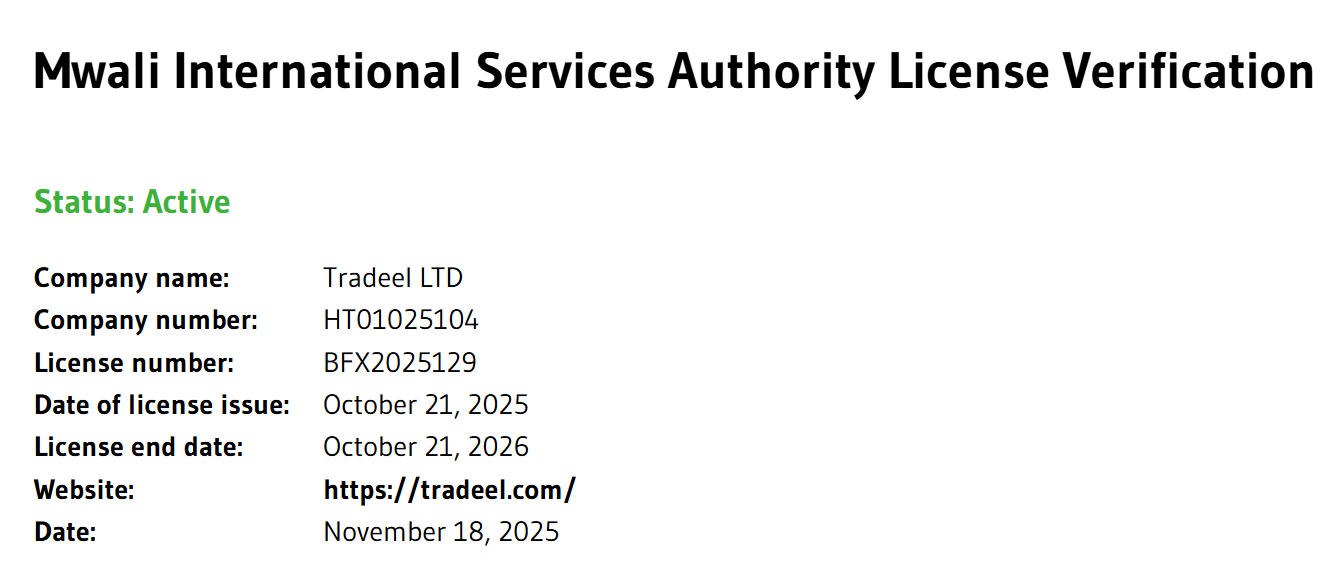
The local registry confirms that Tradeel LTD is indeed registered on the island of Mwali and holds a license issued by MISA on October 21, 2025. It is also stated that the company provides online services via the website tradeel.com.
Formally, this gives grounds to say that the broker is registered and operates in accordance with Mwali legislation and the requirements of the MISA regulator. Unfortunately, this does not provide traders with much reassurance.
At the same time, the licensing process under MISA is extremely simplified. There are no strict requirements regarding physical presence, staff qualifications, capital adequacy, or other key criteria. In practice, this suggests that the regulator effectively sells licenses without ensuring investor protection or proper oversight of brokers. As a result, independent monitoring platforms indicate that the vast majority of brokers licensed by MISA have very low credibility ratings.
All of the above makes this regulator one of the most convenient options for fraudulent projects. Accordingly, an MISA license should not be seen as proof of a broker’s legitimacy, but rather as a potential red flag. Given this, the question arises: how much trust can Tradeel really inspire?
Tradeel.com History
Another important factor is the platform’s lifespan and how long it has been operating online. There are many examples of brokers, even those licensed by reputable regulators, that have ceased operations within months. Among offshore brokers, companies that survive for several years are rare. As for scam projects, the pattern is even clearer — such entities typically disappear within a year after collecting sufficient funds from clients.
On its “About” page, Tradeel mentions years of experience and the trust of thousands of traders. However, as noted earlier, the company only obtained its license in October 2025. While it is technically possible for a broker to operate before formal registration and licensing, this does not enhance its credibility. For more accurate data, we turned to WHOIS domain records.
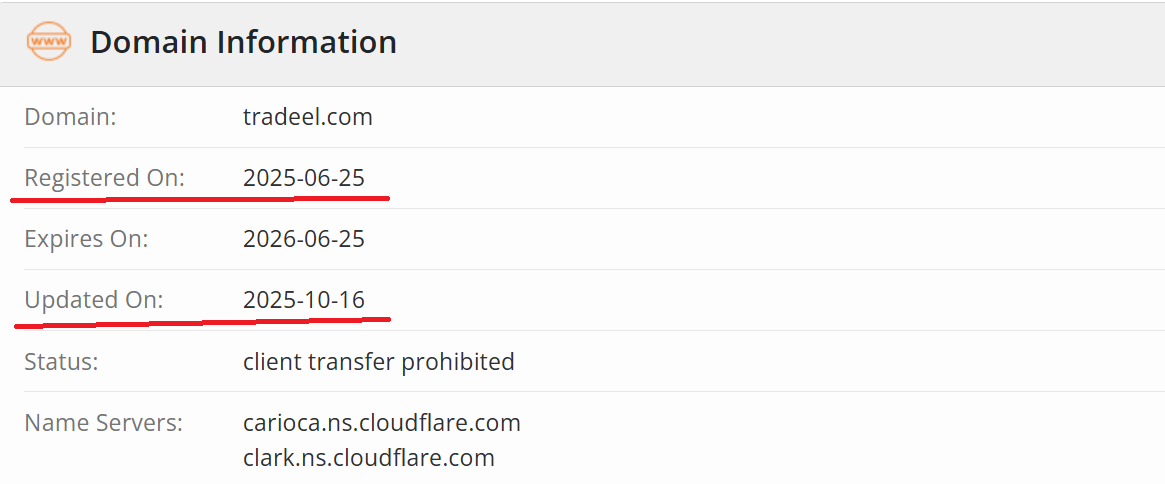
As expected, the findings are inconsistent. According to WHOIS, the domain tradeel.com was registered on June 25, 2025, but snapshots from the web archive show that in July the website had no activity at all. In fact, the domain registrar even prompted the owner to reactivate it.
The date of the last significant update suggests that the fully functional website only appeared shortly before the license was issued in October 2025. This means that as of September 2026, Tradeel has been actively operating for only about a year — clearly not enough time to establish a solid reputation among traders.
The project owners, it seems, have decided to influence the situation themselves. On Trustpilot, there are currently 14 reviews about the broker over a period of 3.5 months since the first tradeel.com review appeared in late January 2026. Interestingly, there are no negative comments among them. In September, for some reason, there were only 8 of them left, also exclusively with ratings of 4 and 5.
At the same time, the company’s scoring on WikiFX fits a completely different picture, standing at 1.91 out of 10. Experts have assigned a “No license” label, reflecting their stance on MISA documentation, which is classified as questionable, and its operating region is suspect.
Due Diligence: Onboarding & Funding
It is also difficult to say anything positive about Tradeel’s client onboarding process. For those who do not prioritize security, it may even seem convenient: the registration form requires only five fields:
- First name.
- Last name.
- Email address.
- Phone number.
- Password.
In other words, within 30 seconds, a user receives an active account, access to the personal dashboard, and the ability to fund the account and start trading without restrictions. During the verification process on April 28, 2026, we immediately entered the client zone. Remaining personal data and verification can supposedly be completed later.
At first glance, this does not seem unusual, since MISA — the regulator under which the broker operates — does not impose stricter requirements. However, industry standards are clearly different. For example, proper onboarding normally includes mandatory email verification during registration and the collection of full KYC and AML data in line with regulatory requirements.
The deposit and withdrawal functionality is described in detail on the “Deposits & Withdrawals” page. It lists a wide range of payment methods, including bank cards, cryptocurrency wallets, e-wallets such as PayPal, as well as SEPA and SWIFT bank transfers. For each method, limits, processing times, and fees are specified. According to the information provided, no deposit fees are charged. By the way, only in this section can you find out the minimum deposit amount ($100), since the broker states that it depends on the payment method, while the same amount is set for all methods.
At first glance, traders might appreciate the company for fully disclosing the conditions of financial transactions. However, inside the Tradeel client area, the situation looks far less attractive. The actual number of available payment methods is significantly smaller: in practice, the broker does not offer bank transfers, PayPal transactions, or several other methods mentioned on the website.
Users are mainly limited to operations in four cryptocurrencies — BTC, ETH, USDC, and USDT — which appear to be treated as the primary payment options. It is also possible to fund accounts directly via debit/credit cards or through intermediary payment processors.
At the same time, clients do not see the recipient’s payment details before sending funds, and in cryptocurrency transactions they never see them at all, since both parties remain anonymous. It would be interesting to hear from the broker how such an approach complies with AML policies. However, judging by the content of the AML/KYC documentation published on the site, the company itself seems to have only a superficial understanding of how such policies should function.
Tradeel Conditions and Manipulations
We constantly emphasize the importance of transparent trading conditions, since only a detailed analysis allows traders to choose a broker that truly matches their goals and expectations.
In this regard, Tradeel raises many questions. Most importantly, why has the broker chosen not to disclose its trading parameters? We reviewed all sections of the official website and could not find even a basic summary of the trading conditions. There is no information about contract specifications either. Apparently, the representatives of a platform claiming to offer more than 4,000 instruments decided that publishing detailed specifications would be too much effort. However, the company did not even provide a list of account types.
From an operational perspective, such a decision may seem rational. However, it remains unclear why the company failed to provide a detailed description of this account and its characteristics. The only logical explanation is that either traders’ needs are poorly understood by the project owners, or they simply do not care about them.
In short, we managed to find exactly two numerical indicators on the official website:
- The broker claims to offer 4,000+ trading instruments across different markets.
- The maximum leverage is stated as 1:1000.
Updated September 10, 2026. Deep within the Client Agreement, we found several more parameters:
- Minimum deposit — $100.
- Minimum withdrawal — $20.
- Non-trading withdrawal fee — up to 20%, no less than $100.
- Inactivity fee after 60 days — $100 per month.
Why could not this basic information be prominently displayed on the website? Well, we can understand the logic behind this approach: apparently, the website creators believe that publishing trade sizes, spreads, swaps, commissions, Margin Call levels, or Stop Out parameters is unnecessary. In their view, registered users can simply check these details in the trading terminal, while website visitors do not need such information.
Once again, this reflects either the qualification level of the company’s staff or their attitude toward potential clients. No consideration is given to the fact that traders usually decide whether to work with a broker based largely on an analysis of trading conditions. If such information is unavailable, many users simply will not register. There is also another possible explanation: the real conditions may be far less attractive than advertised.
In fact, the trading conditions we observed inside the terminal left much to be desired. For example, the spread on EUR/USD exceeds 2 pips, which is several times higher than what most regulated brokers offer. In addition, the parameters displayed in the platform do not match the claims made on the website. We did not count the trading instruments manually, but it certainly appeared that there were far fewer than 4,000 available assets. We also checked the leverage and found that for EUR/USD it was limited to 1:400. The advertised 1:1000 leverage could not be found anywhere.
Tradeel.com Withdrawal Integrity & Exit Process
At this stage, we do not yet have direct evidence regarding the fairness or transparency of withdrawals. However, we strongly advise paying attention once again to the discrepancies between the information about financial operations published on the website and the actual options available in the client area. Additional comments here are hardly necessary.
At the same time, it’s worth discussing the bonus policy in a little more detail, as Tradeel has published its Bonus Terms and Conditions. According to this excellent policy:
- The company reserves the right to award bonuses to clients on an individual basis as a privilege.
- Withdrawals from the account are not possible until the accrued bonuses have been processed (although it is stipulated that the entire bonus amount can be returned somehow).
- The trading volume required for processing is between $10,000 and $20,000 for every dollar of bonus funds received.
Finally, in the General Terms and Conditions, Tradeel reserves some mocking rights:
- The company may terminate services for publishing a “damaging” review.
- The client is prohibited from publicly writing about the company — even positively — without written permission.
- Any liability of the company for losses incurred by the client is limited to the lesser of: commissions paid by the client for three months or $100.
Not to mention such classic reservations as the right to carry out a trading operation even if it is not profitable for the client, as well as to determine quotes at one’s own discretion.
Strengths & Weaknesses Analysis
-
The broker has official registration and a license, albeit offshore.
-
The website provides at least some information regarding non-trading operations.
-
The MISA license used by Tradeel is barely recognized by regulators, experts, or the trading community and does not provide full legal authorization to offer brokerage services in most jurisdictions.
-
Trading conditions are not properly disclosed.
-
The advertised leverage of 1:1000 is excessively risky, while the actual figures shown in the terminal differ from those promoted on the website.
-
Positive reviews published online appear to be commissioned and artificial.
-
Predatory and discouraging bonus policy.
Investment Risk Summary
As demonstrated throughout our Tradeel analysis, the broker’s operations can hardly be described as honest or transparent. Yes, the company holds a license, but it is not regarded as credible by regulators, experts, or traders. At the same time, the platform displays many characteristics commonly associated with scam projects: undisclosed trading conditions, misleading information, and paid positive reviews. Considering these factors, depositing funds with this broker looks extremely risky and may ultimately result in financial losses.



Do not fund accounts with Tradeel. It is unprofitable and, frankly, dangerous for your capital. I decided to warn others because I personally lost $5,000 to these scammers. By the time I realized it was a scam, the losses were already substantial. My last hope is a chargeback service, but even they cannot guarantee recovery – only promise to try…
Tradeel attracted me with promises of profitable investments and rapid capital growth. They claimed that if I deposited $10,000, I could earn the same amount or more within a month. What I did not realize at the time was that scammers are willing to promise absolutely anything while having no intention of operating honestly. That is how these fraudsters ended up taking my money.