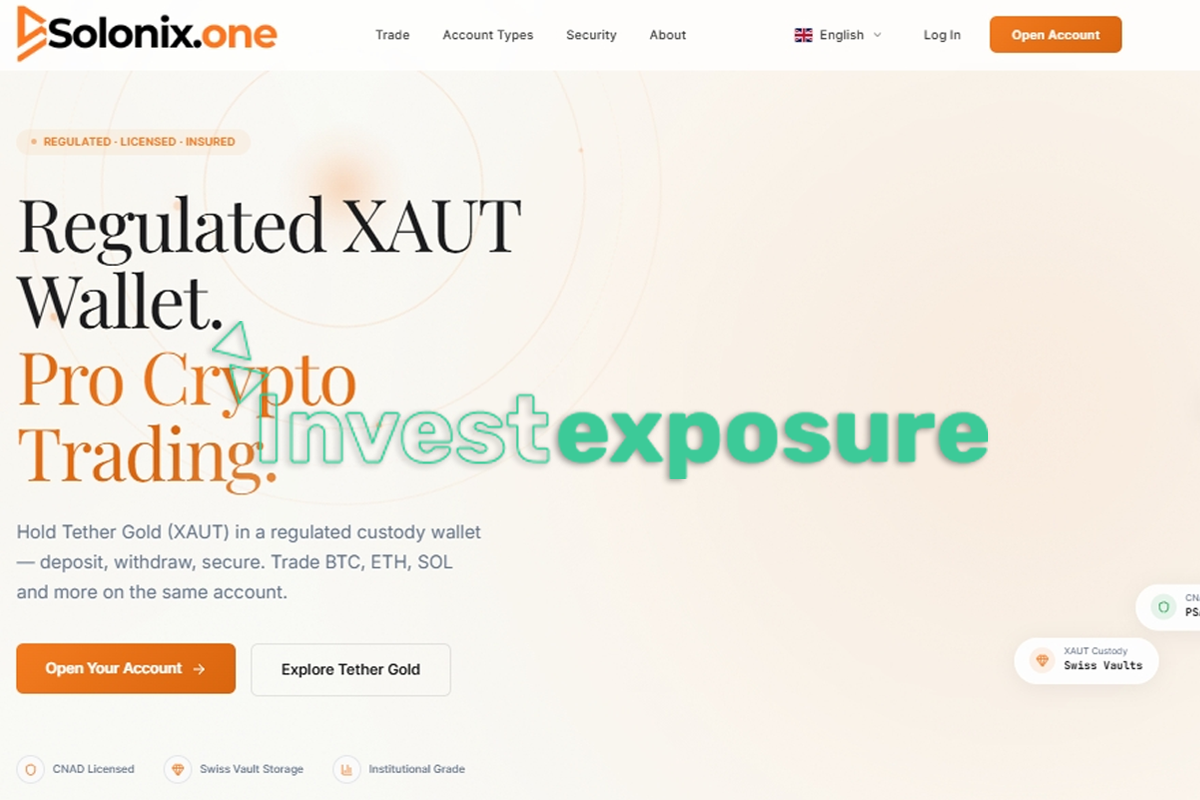
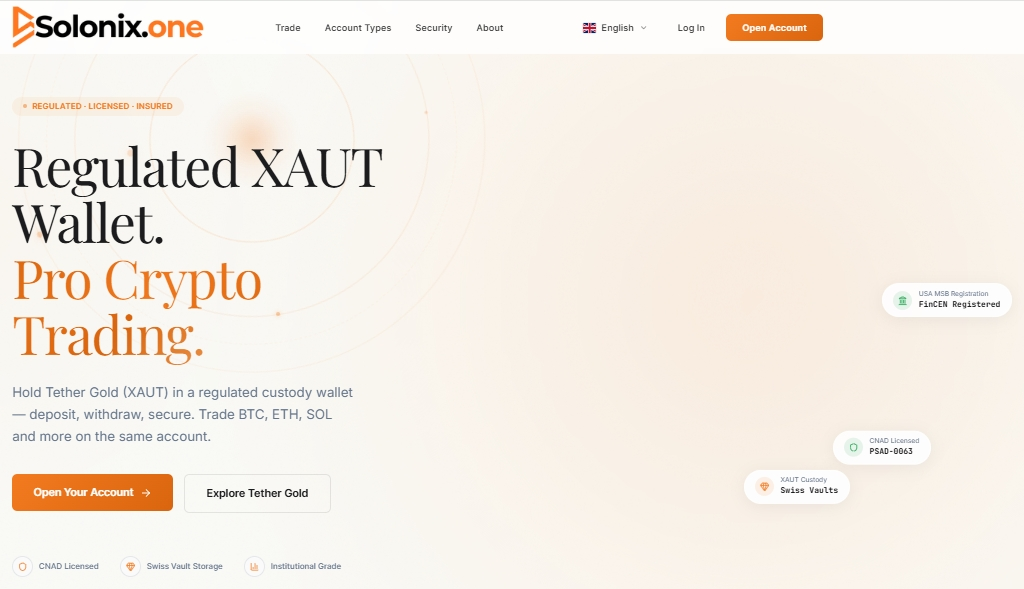
The brokerage firm claims to hold licenses from CNAD in El Salvador and the U.S. FinCEN, displaying direct links to public registries, but its complex legal structure appears suspicious. Is this really a legitimate company, or is it yet another dangerous scam designed to steal cryptocurrency? In this honest Solonix.one review, we’ll take a detailed look at all the hidden nuances of the project and tell you the whole truth about the broker.
Solonix.one Quick Card
| Investigation Date | 24/08/2026 |
| Active Website | https://solonix.one/ |
| Domain Age | Since 16/11/2025 |
| Brand Name | Solonix.one |
| Operating Entity | Digital Trading Group of Central America S.A. de C.V. |
| Stated Jurisdiction | Salvador |
| Blacklist Status | Not found |
| License Status | Verified |
| License Number | CNAD, № PSAD-0063 |
| Office Address | Calle Las Magnolias, Colonia San Benito, Edificio Insigne, Level 14, Office 10, Distrito de San Salvador, El Salvador |
| Phone Number | Not indicated |
| Support Email | support@solonix.one |
| Quick Contacts | Social profiles |
| Company Activities | Crypto asset providing |
| Investing Terms | Not indicated |
| Risk Assessment | High |
Let’s Identify the Company’s Background
The company presents itself as a regulated investment platform for institutional trading in cryptoassets. Gone are the days when the crypto market was a chaotic Wild West — now crypto providers are also subject to compliance requirements, meaning they must hold licenses from reputable regulators. We will investigate whether this project is a legitimate business or simply smoke and mirrors.
Solonix.one Jurisdiction and Regulation
The project’s legal structure is a convoluted web. The trademark is registered in the UAE, payments are routed through the U.S., and additional branches are hidden in Costa Rica and the offshore jurisdiction of Saint Lucia. The main operator is the Salvadoran company DTGoCA. As we discovered, the company lists only a virtual office address in El Salvador.
Meanwhile, pseudo-brokers use this type of artificial fragmentation of the business to achieve legal isolation. Under such a scheme, investors face the following critical risks:
- Branches are scattered around the world, so if a client loses money, it will be impossible to determine the appropriate legal jurisdiction.
- We found that the broker holds a valid document from the Salvadoran regulator (CNAD No. PSAD-0063), but it has no legal force outside that country.
- The platform is not authorized by strict regulators.
- The intermediary disclaims liability by claiming that clients found the website on their own and voluntarily accepted all risks.
Solonix.one History
According to information on the Whois service, the domain was registered on November 16, 2025. Nevertheless, the platform claims to have an institutional status, attempting to project the image of an experienced player. However, the project’s actual history began quite recently, which completely contradicts Solonix.one’s claims of being a time-tested broker.
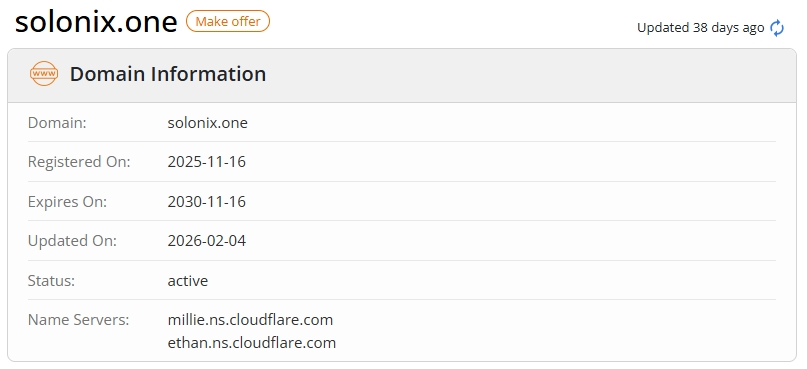
In addition, the creators resorted to a trick and purchased the domain for the period up to 2030. It’s worth noting that major brands do indeed reserve addresses for the long term, but today, pseudo-brokers are actively copying this tactic to lend themselves an air of legitimacy. Furthermore, the most recent update date for the domain record — February 4, 2026 — coincides precisely with the launch of an aggressive marketing campaign for this platform. In other words, this is a typical new venture with the real owners’ information completely hidden.
Due Diligence: Onboarding & Funding
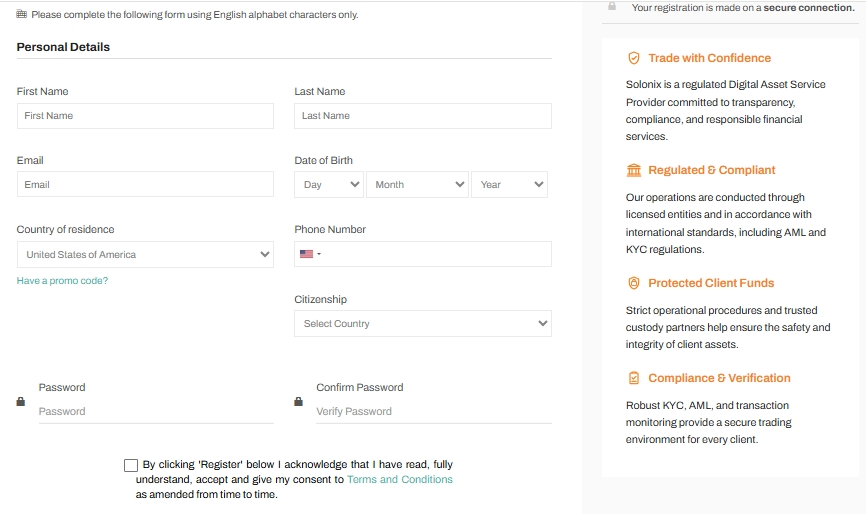
The registration process on the Solonix.one platform is designed to be as simple as possible so as not to create unnecessary barriers for potential investors. The onboarding form collects only basic personal information, requiring immediate email verification.
Interestingly, before filling out the form, there’s a note to use “English alphabet characters only.” This seems odd, as online forms typically accept Latin characters, being unable to handle only other scripts. Even stranger, a broker licensed in El Salvador, a former Spanish-speaking colony, and with a Spanish interface on its website, overlooked the fact that Spanish has diacritics that distinguish it from English.
In any case, we entered the personal account and found ourselves in something very similar to a CFD broker’s standard client area. There’s nothing about promised XAUT Wallet, and the tabs represent the standard path: verification, deposit, trade, withdrawal.
As for verification, it occurs by uploading documents to a third-party service, Sumsub, and there are no relevant regulations. Moreover, you must fill out a short form directly in the personal account, indicating your address and describing your financial situation. Without this, it is impossible to top up the deposit or perform any other actions. The Demo Accounts tab appears to be unclickable by design.
Despite the blocked deposit tab, the system displays three logos as deposit options: stablecoins, Bitcoin, and wire transfers. This is in line with clause 72 of the Terms and Conditions, however, the fees and crediting times remain unknown.
Overall, registering at solonix.one raises many questions. The structure and content of the personal account are significantly less comprehensive than the impressive features described on the website. Client verification before account funding should be considered a plus, but the two-step process is not described in detail and may confuse inexperienced clients.
Solonix.one Conditions and Manipulations
The broker builds its business model around trading popular cryptocurrencies (BTC, ETH, SOL) and providing custodial wallets for the tokenized gold Tether Gold (XAUT). The project’s administration claims to earn revenue from standard commissions, positioning its terms as institutional-grade. Despite this, the platform lacks clear technical documentation (a white paper) or a roadmap.
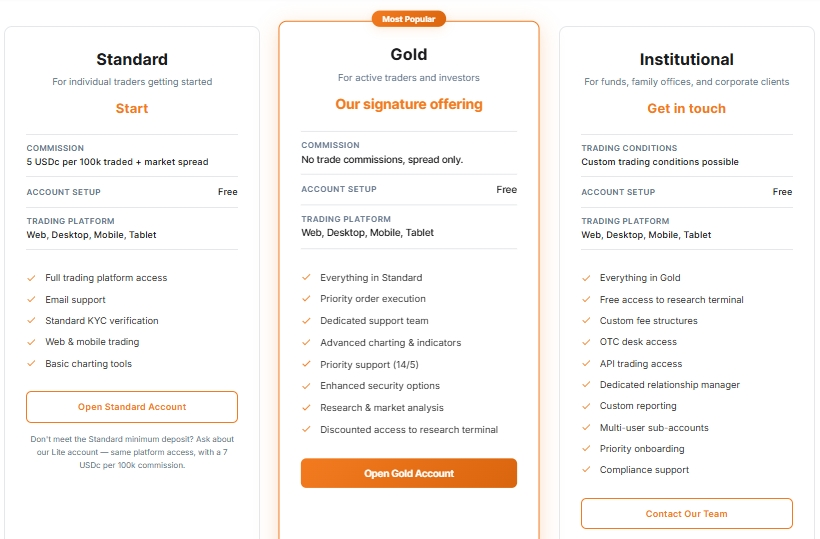
Compared to well-known crypto exchanges, the Solonix.one model appears completely uncompetitive due to hidden fees and a complete lack of transparency in pricing. Meanwhile, a technical analysis of the trading platform and an examination of its fee structures reveal clear signs of a manipulative B-Book ecosystem:
- There are absolutely no mentions of the platform on CoinMarketCap and CoinGecko — the leading independent crypto data aggregators. In addition, clickable links to social media (X, Facebook, YouTube) lead to real profiles, but the number of followers there ranges from just 3 to 20 people, which indicates a very early-stage startup.
- Instead of industry standards (MT4/MT5), a proprietary browser-based trading terminal is offered. The code and quotes are fully controlled by the developers, allowing managers to manually create artificial spread slippage and technical glitches. Moreover, it cannot be tested in the personal account: a message appears stating that access to the terminal requires a deposit of more than $10,000.
- Fixed deposit amounts for the account plans are not specified. A footnote mentioning a “simplified option” for those who do not meet the limits proves that the entry threshold is set manually by managers for specific clients.
- The promise of trading “solely on the spread” on premium accounts is a ploy. The exact spread sizes are not specified anywhere, so the administration can inflate them to any value, deducting money from clients’ accounts.
Solonix.one Withdrawal Integrity & Exit Process
In accordance with the platform’s official rules (clauses 75–79), the withdrawal policy is established exclusively on a unilateral basis. The broker promises to send assets to the original deposit wallets with a minimum withdrawal limit of $10. Despite this, we revealed some critical barriers that make attempting to get a refund an impossible task.
First, when attempting to close an account and withdraw funds, investors encounter hidden pitfalls. Clause 78 of the agreement explicitly states that the company disclaims financial liability for any losses, damages, or expenses arising from the processing of requests. Thus, the administration can invent absolutely any technical glitch on the blockchain or third-party interference to justify the complete disappearance of funds from the account.
Furthermore, according to clause 77, the broker reserves the right to request verification documents at any time at its discretion under strict conditions. There is a 15-day deadline for submitting KYC documents, and if the trader fails to meet it, Solonix.one has grounds to cancel the application and freeze the balance.
The situation is exacerbated by the complete disregard from customer support, as the website lacks any direct phone numbers or physical office addresses for prompt dispute resolution. If problems arise, clients may find themselves ignored, as customer support communicates only through a one-way online format and can block the account of an undesirable user at any moment.
Strengths & Weaknesses Analysis
-
A genuine Salvadoran license.
-
Clickable social media links.
-
Support for Tether Gold.
-
Lack of Tier-1 licenses.
-
Lack of XAUT wallet.
-
A confusing network of virtual offices.
-
False claims about digital asset insurance.
-
A hidden minimum deposit threshold.
-
Complicated KYC verification.
-
An isolated B-Book platform.
-
Risk of being ignored by customer support.
Investment Risk Summary
Solonix.one is not a profitable project; partnering with it carries maximum risk. Despite holding a valid license in El Salvador, the platform deceives clients by passing off a local document as international authorization. Furthermore, the closed B-Book terminal, hidden fees, and exploitative terms and conditions are designed solely to lure out deposits. We do not recommend investing a single cent in this company, which completely absolves itself of financial responsibility and can block the withdrawal of your funds at any time.