

We have long been accustomed to scam projects attracting users with supposedly original offers. However, as it turns out, not every such broker knows how to capture a client’s interest. As a result, all they can do is promise traders the same old things: access to a wide range of trading instruments, a platform with fast order execution, and competitive trading conditions. In this TradGrip review, we take a closer look at one such project. Below, you will find the details of this platform created by scammers.
TradGrip Quick Card
| Investigation Date | 07/07/2026 |
| Active Website | https://www.tradgrip.com/ |
| Domain Age | Since 14/08/2024 |
| Brand Name | TradGrip |
| Operating Entity | Zenith Markets PLC |
| Stated Jurisdiction | Mwali (Moheli), Comoros Umion |
| Blacklist Status | Diclose by JFSA (Japan) – unauthorized entity Zenith Markets PLC 01/06/2025 |
| License Status | Verified |
| License Number | MISA BFX2024031 |
| Office Address | Bonovo Road, Fomboni, Comoros, KM |
| Phone Number | +441863440820 (UK), +441970450369 (IN), +815031041589 (JP) |
| Support Email | support@tradgrip.com |
| Quick Contacts | Live chat |
| Company Activities | Brokerage |
| Investing Terms | $250 |
| Risk Assessment | High risk |
Let’s Identify the Company’s Background
We constantly remind users that a broker’s profile is made up of several key components:
- Official registration.
- Operation under a valid license, preferably issued by a reputable regulator.
- Solid experience in providing services.
- Full disclosure of trading conditions.
- Transparency of non-trading operations.
- The quality of the official website.
- The quantity and content of publications available online.
Problems with any of these aspects may indicate that the platform is operating dishonestly or illegally. Moreover, the more red flags we identify, the higher the probability that we are dealing with a scam. When preparing our reviews, we usually examine all of these factors. That is exactly the approach we took in our tradgrip.com review.
TradGrip Jurisdiction and Regulation
The team presents the broker as a fully regulated company operating under the management of Zenith Markets PLC. The website provides information about the company’s registration on the autonomous island of Mwali (Moheli), part of the Union of the Comoros, as well as its license issued by the local financial regulator, MISA (Mwali International Services Authority).
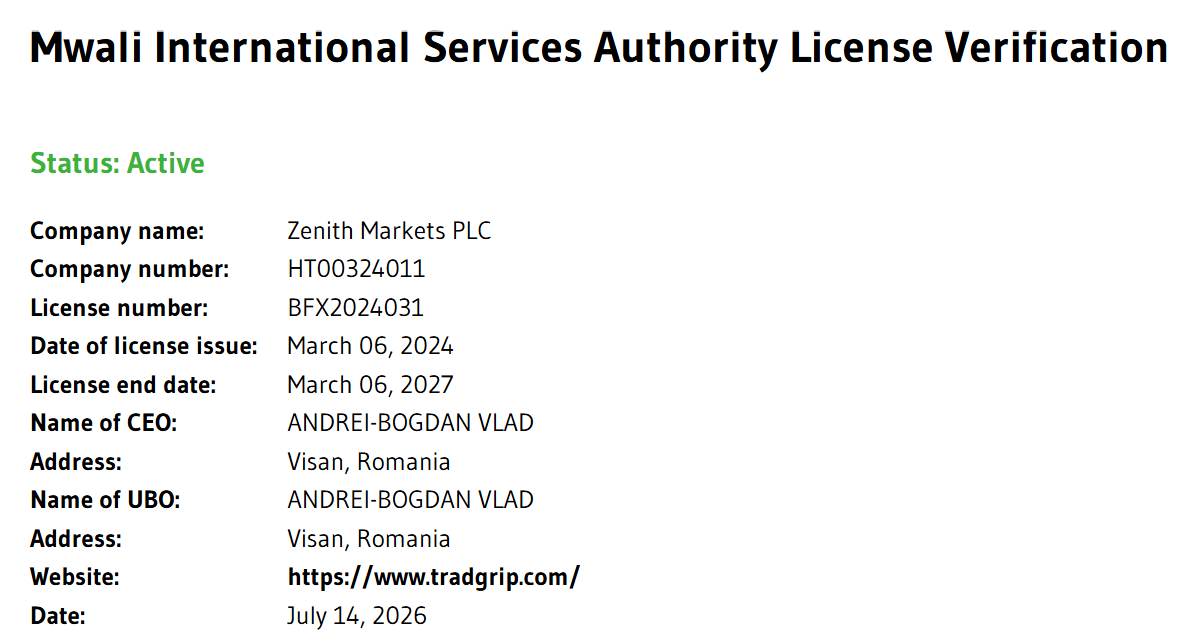
We obtained data from the regulator’s public register. All of the information published on the broker’s website was fully confirmed. The company Zenith Markets PLC is indeed:
- Registered under No. HT00324011.
- Holder of MISA License No. BFX2024031, issued on March 6, 2024, and already renewed twice through March 6, 2027.
- The operator of the website https://www.tradgrip.com/.
In fact, we obtained full confirmation of the broker’s official registration and the fact that it operates under a valid license. Does this mean it can be trusted without reservation?
Not at all. The problem is that there are far too many questions surrounding both the jurisdiction and the regulator. Mwali (Moheli), like the Union of the Comoros as a whole, has earned a reputation as a “grey” offshore jurisdiction. Doing business with companies registered there is risky, especially when it comes to the financial sector, including Forex/CFD brokers.
Moreover, there are numerous contradictions even within the country itself. The authorities of Moheli maintain that the island enjoys autonomous status. They interpret this autonomy quite broadly: organizations operating on the island are considered entitled to resolve any matters independently, including those related to international economic activities. Consequently, according to their position, documents issued by institutions operating on the island possess full legal force.
The international professional community views this situation quite differently. First of all, there are serious doubts that international standards and the decisions of organizations such as the FATF are actually implemented at an adequate level. And these doubts are supported by substantial evidence.
Local laws make this registration option attractive to business operators who would likely face serious obstacles in most other jurisdictions. They are able to obtain the necessary documents within a very short timeframe: 1–2 weeks for company registration alone, and approximately 4–6 weeks if a license from the local financial regulator is also required. The cost is relatively low as well: approximately €500–1,500 for registration and another €1,600–3,800 for licensing. In practice, however, the registration procedure largely comes down to entering a paid record into a register administered by a private entity. The scale of the problem is demonstrated by the fact that major banks and international payment systems often prefer to avoid any cooperation with companies registered in Mwali.
The situation with the Mwali International Services Authority (MISA) is even more controversial. Banque Centrale des Comores (BCC), the principal financial regulator of the Union of the Comoros, consistently maintains that the authority to license financial institutions belongs exclusively to it. According to the BCC, the island’s autonomous status does not grant it an independent financial jurisdiction. Consequently, MISA’s activities are regarded as illegitimate, and the documents it issues are considered legally void. The BCC has repeatedly expressed this position in its official press releases. Incidentally, this assessment is shared by international institutions such as the IMF, the World Bank, and the FATF.
Finally, it is impossible to ignore the fact that the requirements imposed on financial companies, including Forex/CFD brokers, are so lenient that they provide virtually no meaningful mechanism for client protection. As a result, Mwali International Services Authority licenses have not been recognized by independent experts or by the majority of foreign regulators, and companies holding such licenses are effectively unable to provide brokerage services legally in most countries around the world.
Tradgrip.com History
We found no information about the broker’s history on its website. Judging by the date on which it obtained its MISA license, its full-scale operations began only in 2024. However, the possibility that it operated without a license during its early stages cannot be ruled out. Therefore, we attempted to determine the project’s actual launch date more precisely.
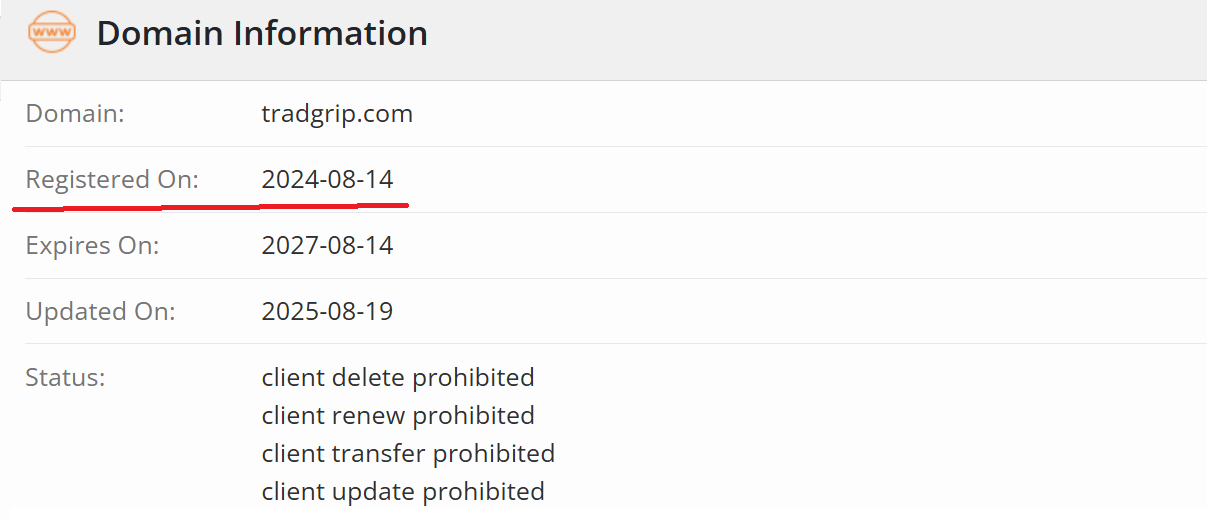
The WHOIS service helped us in our search for historical data. As we can see, according to its records, the project’s active domain was registered on August 14, 2024, four months after the company obtained its license. This gives us grounds to conclude that the platform’s online operations began after that date, making the broker just under two years old at the time of writing this tradgrip.com review.
At first glance, this appeared to be a straightforward case where information from different sources was fully consistent. However, it turned out that the first TradGrip review on Trustpilot was published only on June 24, 2025, almost a year after the domain registration. This means that either users had no reason to comment on the broker’s services for an entire year, or the platform simply was not operating. Interestingly, the first snapshot of the broker’s website captured by the Web Archive also dates back to February 2025. As a result, we were unable to determine the exact launch date, but we can confidently state that the project has been operating online for approximately 1.5–2 years.
During that time, Trustpilot accumulated only 37 comments about the broker. That is not a large number, but the portal itself indicates that there were significantly more. Fake, most likely positive, reviews were removed, and the calculation of TradGrip’s rating was suspended due to violations of the platform’s rules.
What does this tell us? The project’s owners attempted to build an artificial reputation by paying authors to publish positive reviews about the broker. After Trustpilot’s administration intervened, it became clear that genuine user opinions were predominantly negative — 64% of the remaining reviews fall into that category.
Due Diligence: Onboarding & Funding
Our first impression of the official TradGrip website was generally negative. Although the design is reasonably well executed, it is not without flaws, particularly in font selection and page scaling. The site’s optimization deserves praise, while its menu structure deserves serious criticism. At the same time, behind its attractive appearance lies a shortage of genuinely valuable information: users will find almost nothing that is of practical use to traders.
It is worth noting that we did not intend to conduct a detailed analysis of the broker’s website. Our primary interest lies in more practical matters: the registration process and the functionality of the client area.
The account creation process is fairly logical and largely follows the standards used by licensed brokerage companies regulated in Europe. However, the collection of personal information is unnecessarily divided into several stages — the KYC process alone requires users to complete two separate forms.
During the following steps, users are asked to complete a questionnaire (employment status, income and its source, expected investment returns, planned investment amounts, etc.), pass verification, and fund their account. This raises an interesting question: what is the likelihood of losing access to your money already at this stage?
Let’s consider a hypothetical scenario. A user submits the full set of documents and transfers funds. However, after the verification process is completed, the application is rejected. In such a case, the user’s funds remain blocked within the system until the documents are approved. But what if they are never approved? And what happens if the company’s employees deliberately delay the verification process for two or three months?
However, this is not the only issue. Although the list of restricted areas published on the website is relatively short, actual access to the broker’s services is denied to residents of many countries. For example, our colleague from Chile was unable to complete the registration process (like everyone else, he received a message stating that residents and citizens of his country are not accepted by the broker). At the same time, after contacting customer support, a user with a European IP address and phone number was manually registered. It seems that there is something about the transparency and legality of TradGrip’s operations that we simply do not understand.
By the way, the broker’s client geography is quite interesting. Information available online (including, in part, on the WikiFX portal) suggests that the majority of its clients come from India, Japan, France, and Turkey. However, France, for example, is part of the EU & EEA, which TradGrip itself lists among its restricted areas. The situation with the other countries is no better:
- India. The country’s legislation, particularly the Foreign Exchange Management Act (FEMA), imposes extremely strict restrictions on residents dealing with foreign over-the-counter trading platforms. Market participants are permitted to trade only the Indian rupee/U.S. dollar currency pair, and only through officially recognized exchanges. Any OTC transactions are completely prohibited. Moreover, every financial service provider must obtain authorization/licenses from both SEBI (Securities and Exchange Board of India) and the Reserve Bank of India (RBI). Notably, violations of these requirements by traders may result in penalties up to and including criminal prosecution. This means that the broker is not only operating illegally itself but is also putting its clients at risk.
- Japan. The rules here are somewhat more flexible. To provide brokerage/dealer services legally, a company must be authorized as a Type I Financial Instruments Business Operator (the license is issued by the JFSA). Membership in the Financial Futures Association of Japan (FFAJ) is also mandatory. Without these, the trading platform’s activities are considered illegal, while its clients act entirely at their own risk, although they still remain obligated to pay taxes.
We could end our analysis here, but there is one more fact that cannot be ignored. The company accepts deposits not only in fiat currencies but also in cryptocurrencies. This approach directly contradicts the platform’s own AML Policy, since compliance with anti-money laundering procedures is impossible when the sender remains completely anonymous and the source of the funds cannot be traced. Furthermore, this practice conflicts with the national legislation of the broker’s target markets. For example, any Indian entity dealing with cryptocurrencies must register with FIU-IND as a VASP and strictly comply with the requirements of the Prevention of Money Laundering Act (PMLA). Neither the official website nor the client area contains even a mention of these obligations.
It is worth noting that the TradGrip administration has made considerable efforts to create the appearance of a trustworthy service. However, everything discussed above represents a classic red flag, clearly indicating a high level of risk for the platform’s clients.
TradGrip Conditions and Manipulations
The platform’s representatives claim that its trading conditions are among the best in the industry. Naturally, we examined the actual trading parameters to assess how attractive they really are for traders. Let us begin with a few words about the available account types.
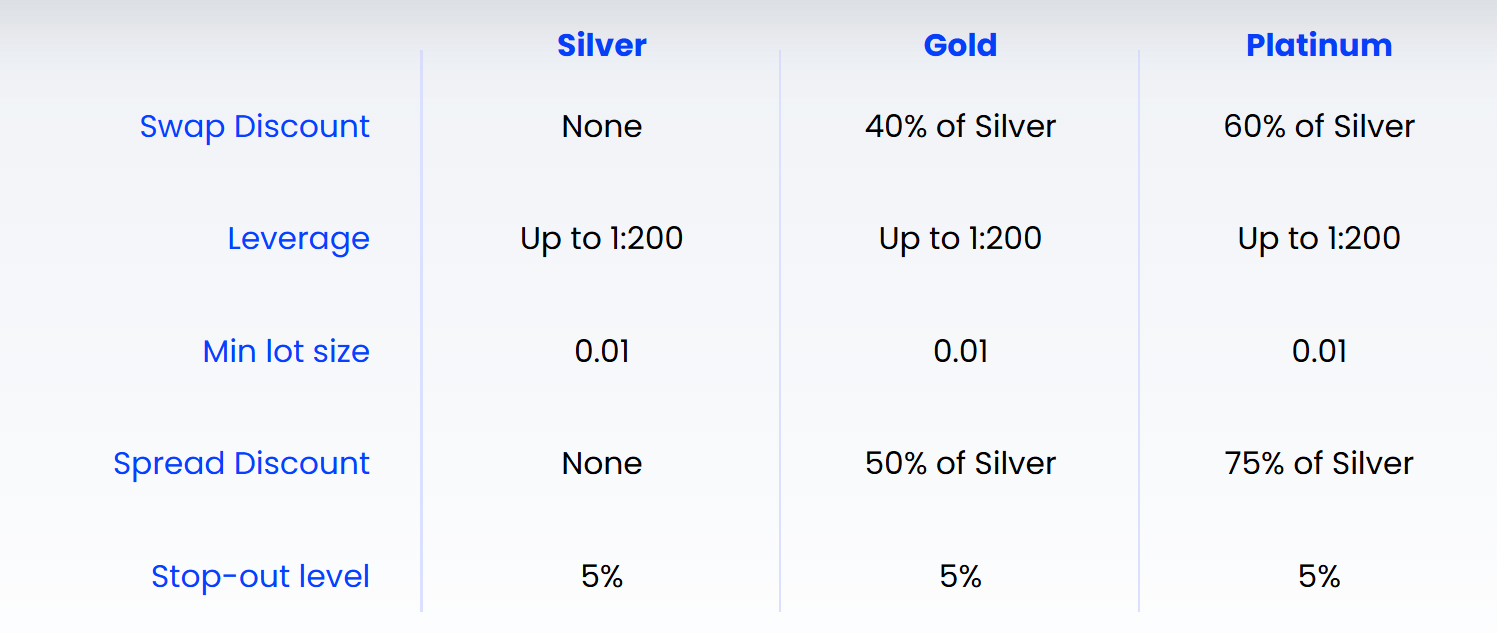
TradGrip offers three account tiers: Silver, Gold, and Platinum. Their core trading conditions are identical:
- Maximum leverage: 1:200.
- Minimum trade size: 0.01 standard lot.
- Stop Out level: 5%.
Interestingly, the broker declares the same approach in its Contract Specification document (available on the Legal page). According to it, the 0.05% margin requirement, equivalent to 1:200 leverage, should be available only to clients classified as professional traders. Retail clients are supposedly limited to a 3.33% margin requirement (1:30 leverage). However, we never observed the company carrying out any client categorization. We were also given access to 1:200 leverage, just like every other user.
The differences between the account types are limited to discounts on spreads and swaps. The standard swap rates for the Silver account are listed in the same contract specification document.
However, the broker does not disclose the current market spreads. We are inclined to believe that the advertised reduction in trading costs may be significantly overstated. For example, if the base spread is 2 pips, then the Platinum account’s advertised 60% discount would reduce it to 0.8 pips, which is fairly typical for regulated brokers. At the same time, the minimum deposit requirement for this account is not disclosed. It may well turn out that traders must deposit tens of thousands of dollars to qualify. In that case, what exactly is “competitive” about these trading conditions?
Tradgrip.com Withdrawal Integrity & Exit Process
Everything we mentioned about funding accounts was learned from the broker’s client area. However, the official website provides virtually no details about financial transactions. The FAQ contains only a few scattered pieces of information, such as the fact that the minimum withdrawal amount is 50 USD. Nothing is said about other limits, processing times, or applicable fees.
Former and current TradGrip clients, however, have much more to say about withdrawals. As we mentioned earlier, the majority (62%) of reviews on Trustpilot are negative. In almost every one of them, users claim that the broker either delays processing withdrawal requests or refuses to pay out funds altogether. Frankly, this is exactly what one would expect from a scam project.
Strengths & Weaknesses Analysis
-
The broker is officially registered and operates under an active MISA license.
-
Trading can be started with as little as $250.
-
The license held by the operating company is recognized by almost no regulators and provides little to no real protection for traders.
-
The company collects an excessive amount of clients' personal data during registration without clearly explaining why.
-
The conditions for deposits and withdrawals are not disclosed.
-
Contract specifications are available, but they still fail to provide a complete picture of the trading conditions.
-
Most online reviews and expert ratings of the platform are negative.
Investment Risk Summary
In our TradGrip review, we highlighted the broker’s major shortcomings. There are plenty of them: operating under an internationally unrecognized license, trading conditions that are difficult to call competitive, undisclosed terms for financial transactions, and more. In our opinion, the company deserves a negative assessment, a view shared by the majority of reviewers across the internet.



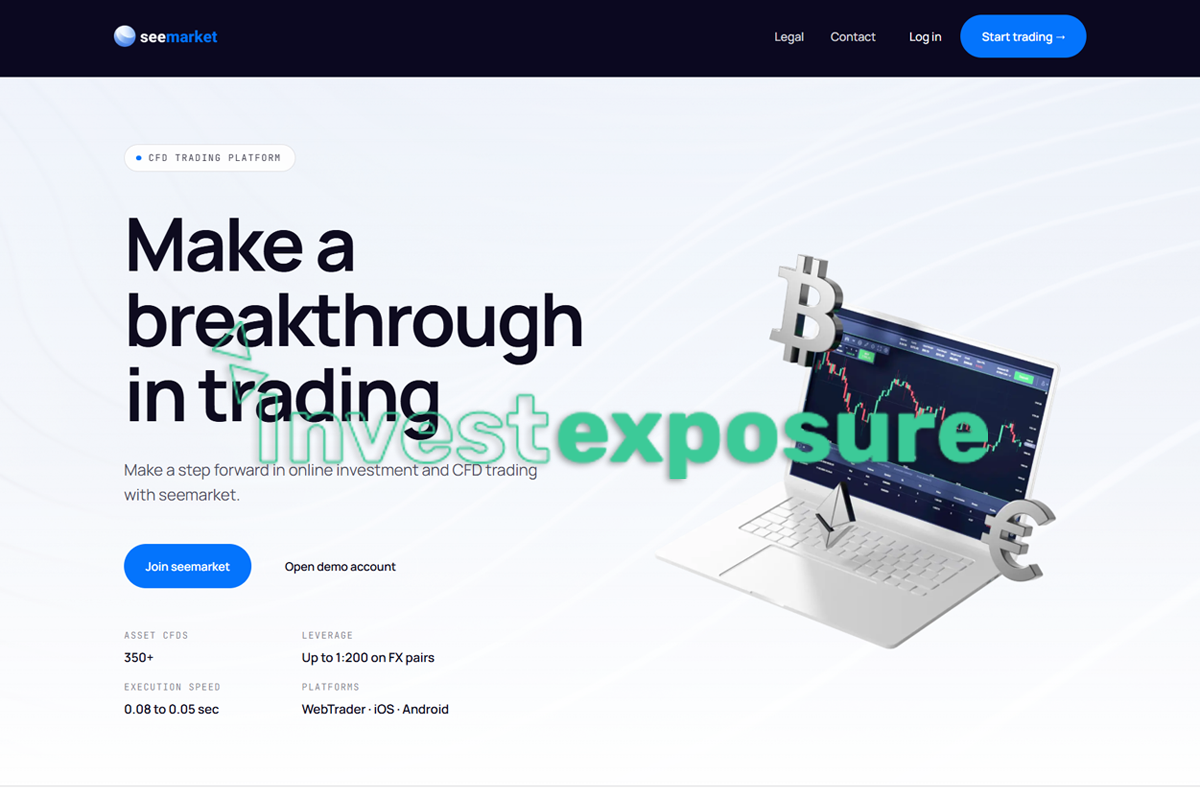

I usually don’t write reviews, but the scammers at TradGrip practically forced me to do it. I was always fine with waiting a couple of days for a withdrawal – submitting a request today and receiving the money a day or two later. But here I was unpleasantly surprised. I submitted a withdrawal request and have now been waiting for the second week. Every time I contact support, they come up with a different excuse for why my funds cannot be released and ask for something else -more documents, proof of the source of my funds, and so on. I think this is a SCAM and I will never see my money.