

We present to you a detailed CapPlace review, in which we take a closer look at a Forex/CFD broker that is making a strong effort to appear as a reputable and regulated company. Its official website promises clients access to more than 300 trading instruments, competitive trading conditions, and professional customer support. However, after a more thorough examination of the platform, we were left with the impression that this may be yet another scam operation. Why do we think so? We explain our findings in the analysis below.
CapPlace Quick Card
| Investigation Date | 16/06/2026 |
| Active Website | https://www.capplace.com/ |
| Domain Age | Since 02/03/2006 |
| Brand Name | CapPlace |
| Operating Entity | Robertson Finance Inc. |
| Stated Jurisdiction | Mwali (Moheli), Comoros Union |
| Blacklist Status | Not found |
| License Status | License by MISA |
| License Number | T2023294 |
| Office Address | Bonovo Road, Fomboni, Comoros, KM. |
| Phone Number | +815031264259, +447458196365, +447418353612 |
| Support Email | support@capplace.com |
| Quick Contacts | Live chat |
| Company Activities | Brokerage |
| Investing Terms | Min. deposit 250 USD, leverage up to 1:200 |
| Risk Assessment | High risk |
Let’s Identify the Company’s Background
Today, countless scam platforms appear online every day. Each of these projects tries to convince traders that it operates legally and offers the best trading conditions available. Interestingly, some of these stories are crafted so convincingly that distinguishing a fake company from a legitimate one can be extremely difficult. This is why a thorough analysis of all available information about a broker is essential. That is exactly where we began our capplace.com review.
CapPlace Jurisdiction and Regulation
It is refreshing that the broker does not make the task more difficult by concealing information about its registration and licensing status. In the website footer and the Terms & Conditions document, CapPlace states that it operates under Robertson Finance Inc., a company officially registered on the autonomous island of Mwali (Mohéli), which is part of the Union of the Comoros. The company registration number is HY00523519, and it reportedly holds a brokerage license issued by the local financial regulator, the Mwali International Services Authority (MISA).
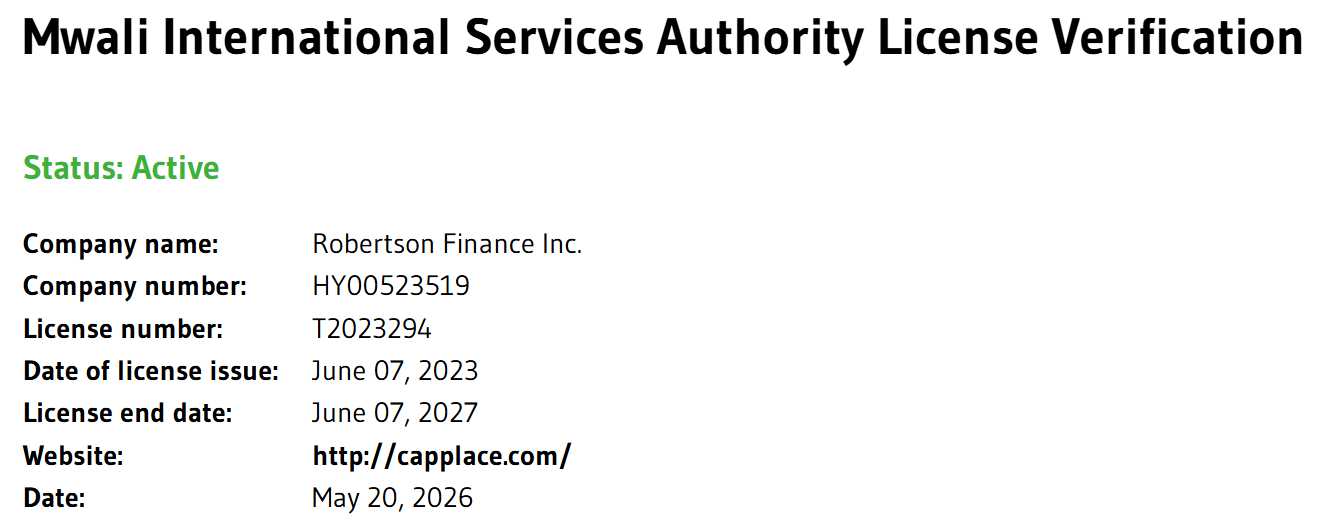
Verifying these claims is relatively straightforward, as the relevant information is available in the MISA registry. As we can see, the search of the regulator’s database was successful. The verification confirmed that:
- Robertson Finance Inc. is indeed registered under number HY00523519.
- The company received a brokerage license No. T2023294 on June 7, 2023, and has already renewed it for an additional year, extending its validity until June 2027.
- The company is also listed as the owner of the capplace.com domain and the website operating on it.
Does this mean that the broker is genuinely legal and regulated? Formally, yes, but the situation is not that simple. The key issue is that a MISA license does not enjoy widespread recognition among international organizations, major financial regulators, or even many industry experts. As a result, its existence alone cannot be considered sufficient proof that the broker provides services within a reliable regulatory framework.
There are at least two reasons for this:
- The financial regulator of the Union of the Comoros, Banque Centrale des Comores (BCC), does not recognize the authority of regulatory bodies established by the governments of the autonomous islands to license and supervise financial service providers. In official statements, the BCC has described such entities as commercial organizations operating independently and has argued that the licenses they issue carry no legal force.
- MISA itself provides very limited regulatory oversight. The authority imposes virtually no meaningful restrictions on brokerage companies or the trading conditions they may offer. It does not conduct regular supervisory inspections, does not require audited financial statements on an ongoing basis, and possesses few effective mechanisms for enforcing compliance among license holders. As a result, obtaining a MISA license does not provide the same level of investor protection that traders would expect from well-established regulators in major financial jurisdictions.
Should it come as a surprise that between 2023 and 2026, the number of company registrations in the Union of the Comoros increased dramatically, with the overwhelming majority concentrated on two autonomous islands—Mwali (Mohéli) and Anjouan, whose regulators are specifically criticized by the BCC? At the same time, a remarkably high percentage of these newly established offshore entities appear to be associated with fraudulent projects. Of the firms that received licenses in 2023, only around 20% are still operating today. For those licensed in 2024, the figure is estimated to be no more than 40%. In our view, these statistics speak volumes about the quality of the regulator and the value of the licenses it issues.
As a result, CapPlace does possess an officially issued license to provide brokerage and dealing services in the Forex/CFD market. However, in our opinion, this fact does little to increase the company’s credibility.
Capplace.com History
As established from the official documents, Robertson Finance Inc. was incorporated and licensed in 2023. Beyond that, the broker’s website provides very little information about its history. Therefore, we turned to publicly available sources. One of the easiest ways to trace a company’s online presence is through domain registration records available via WHOIS services.
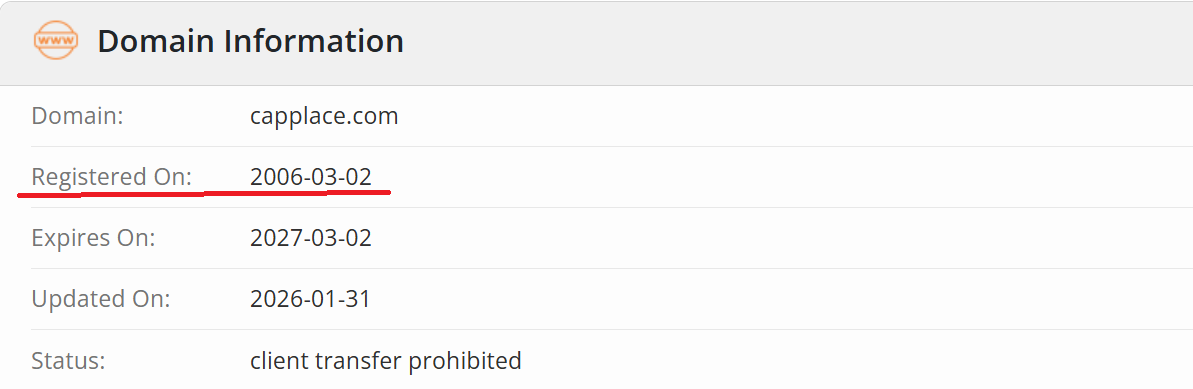
The data shows that the capplace.com domain was originally registered more than 20 years ago, on March 2, 2006. Naturally, the current owners acquired it much later, most likely after completing the registration and licensing procedures in 2023. This conclusion is supported by records from the Internet Archive. The first archived snapshot showing a fully functional broker website dates back to 2024, while earlier snapshots reveal that the domain had been listed for sale for several years prior to that.
Accordingly, it is reasonable to conclude that the platform has been operating online for approximately two and a half years. While this is far from the track record of established industry veterans, it is sufficient time to develop a reputation among traders.
Interestingly, CapPlace appears to have made efforts to shape that reputation on its own. The first review of capplace.com on Trustpilot was published in September 2024. Since then, around 40 reviews have appeared on the platform. However, we suspect that the actual number may have been significantly higher. Trustpilot currently displays a notice indicating that the company’s rating is not being calculated due to violations of the platform’s rules. We believe that a number of positive reviews, potentially commissioned by the project’s operators, may have been removed.
As things stand, approximately 85% of the remaining comments are strongly negative. The complaints are remarkably similar: users claim that the broker manipulates quotes in its own favor and shows little willingness either to pay out profits or return deposited funds.
The broker also receives poor evaluations on specialized industry portals. For example, its WikiFX score is only 1.34 out of 10. The platform explicitly warns visitors to exercise caution when dealing with CapPlace due to the absence of a reputable regulatory license.
Due Diligence: Onboarding & Funding
The official CapPlace website did not leave the best impression. The main design issue is the use of massive content blocks that successfully incorporate thematic images and clearly visible headings, but make the explanatory text difficult to read due to poor font-size choices.
The content itself is not much better. For example, on the Markets page, the broker manages to describe each available market in just a couple of sentences. How much useful information can traders realistically obtain from such brief descriptions? Another example is the list of exchange holidays and non-trading days across various countries. Apparently, these are the essential details traders cannot live without (sarcasm intended). Meanwhile, there was somehow no room on the website for genuinely useful tools such as a news feed or an economic calendar.
What truly surprised us, however, was the client registration process. Users are required to complete a series of forms asking for virtually every piece of personal information imaginable, including their taxpayer identification number. Why does the company need this information when it cannot act as a tax agent in any jurisdiction? We were unable to find a convincing answer to that question.
Personal data is not the only thing CapPlace asks traders to provide. Prospective clients must also complete a questionnaire detailing their financial situation as well as their trading and investment experience. This extensive information gathering seems unusual, especially considering that the company does not perform any meaningful client categorization and its regulator does not require such detailed disclosures.
It should also be noted that not everyone can successfully create an account. The license held by the company only provides a legal basis for operating in jurisdictions where local registration and regulation of financial services are not required. As a result, CapPlace maintains an extensive list of restricted regions. Many users report receiving a notification stating that the broker “is not available in your location or to residents of your country” immediately after submitting the initial registration form.
While this restriction is not necessarily an insurmountable obstacle, it creates a situation in which the platform’s administration could potentially refuse service or deny withdrawals to certain clients at any time. From a legal standpoint, such actions could still be justified under the company’s own terms.
When it comes to financial transactions, CapPlace remains true to its usual approach. For example, the list of available payment methods appears quite impressive at first glance. According to the FAQ section, clients can fund their accounts via bank transfers, debit and credit cards, electronic payment systems, and even cryptocurrency wallets.
In reality, traders are presented with roughly a dozen payment options, but only card payments and cryptocurrency transfers seem to function consistently. A significant number of the listed payment providers are either region-specific or simply do not process transaction requests.
Overall, we have several questions for the broker:
- Why does the company rely on third-party payment intermediaries instead of accepting deposits directly through its own bank accounts and payment cards?
- Why are the terms of financial operations not disclosed anywhere? There is no information regarding transaction limits, processing times, or fees.
- How do anonymous cryptocurrency transactions comply with the broker’s stated AML policies?
In short, we found very little positive to say about the funding process. In fact, the deeper we looked, the stronger our impression became that we were dealing with a typical scam operation.
CapPlace Conditions and Manipulations
The broker’s disclosure of trading conditions genuinely deserves some praise. Users can access most of the important information before even registering an account.
Let us begin with the account types page. CapPlace offers only three account categories: Silver, Gold, and Platinum. The broker provides only their key characteristics.
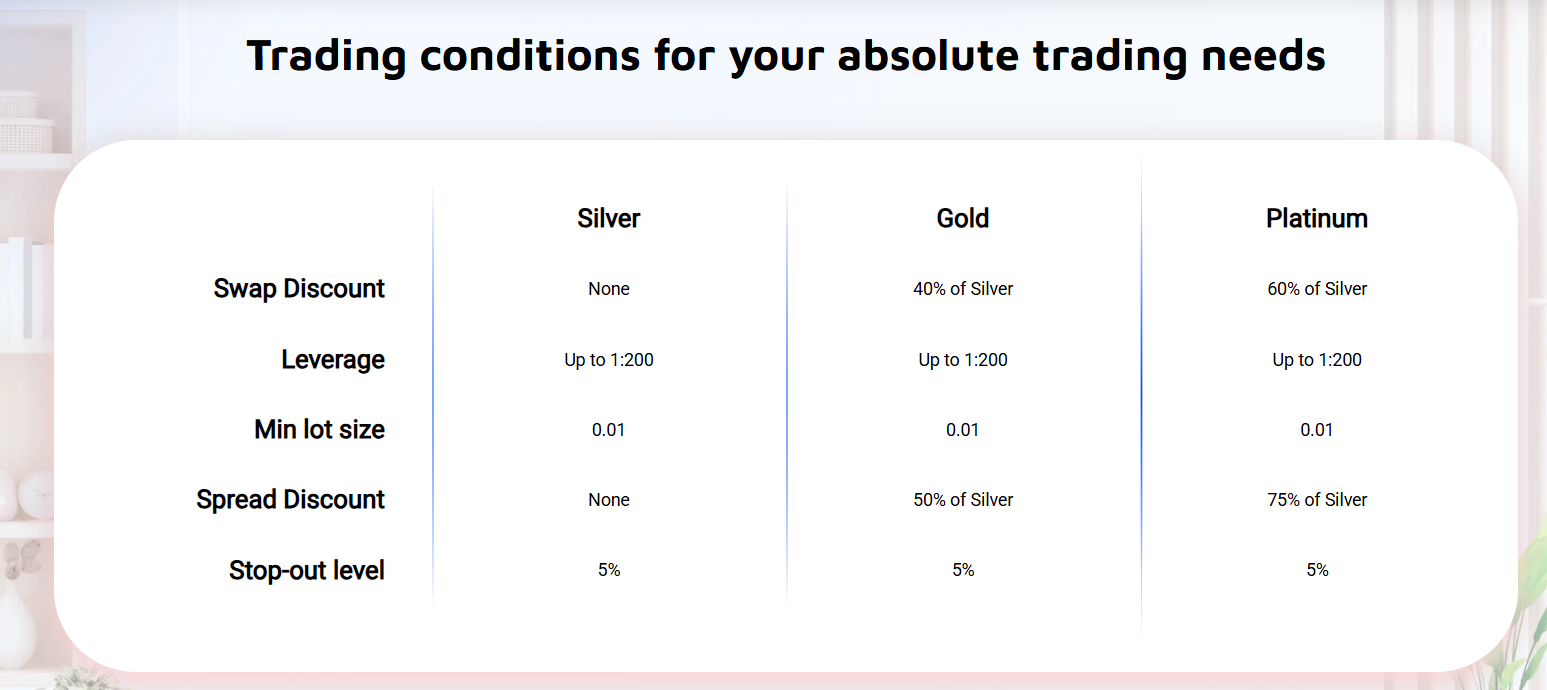
Among the published parameters, traders can find:
- Maximum leverage of up to 1:200 for all account types;
- Minimum position size of 0.01 standard lots;
- Stop Out level of 5%.
The page also contains an interesting detail: discounts applied to spreads and swaps relative to certain base values, which appear to correspond to the Silver account conditions. Gold account holders receive a 50% discount on spreads and a 40% discount on swaps, while Platinum clients are offered reductions of 75% and 60%, respectively.
Naturally, this information alone is insufficient for making a well-informed decision about whether to trade with the broker. For example, calculating actual trading costs is impossible because the underlying values from which these discounts are derived are not disclosed.
However, the account descriptions are not intended to provide a complete specification of trading conditions. For that purpose, the broker publishes an official document called Contract Specifications in the Legal section of the website. This document does, in fact, contain most of the key trading parameters for each of the available instruments.
We found the contents of the document quite interesting. It does indeed include many of the core trading parameters, allowing traders to view:
- Minimum and maximum position sizes;
- Base swap rates (for the Silver account) for both long and short positions;
- Trading hours during which each instrument is available.
However, the most intriguing information concerns margin requirements. To begin with, the document lists two separate values: one for retail traders and another for professional traders. This immediately raised questions, prompting us to revisit the website and the client area. Despite our efforts, we were unable to find any mention of a client categorization process.
Who, then, are these margin requirements intended for?
The figures themselves are significant. Retail clients are assigned a margin requirement of 3.33%, while professional clients are subject to a 0.5% requirement, corresponding to leverage ratios of 1:30 and 1:200, respectively. The retail limit is designed to reduce risk exposure substantially. However, as already mentioned, the broker does not appear to classify traders into different categories.
We found direct evidence of this in the CapPlace trading platform. One of our team members registered an account using information that clearly did not qualify him as a professional trader. Nevertheless, he was still granted access to leverage of 1:200 when trading currency pairs. As you can imagine, such leverage exposes inexperienced traders to risks far beyond what would normally be considered reasonable.
Another trading parameter that deserves attention is the Stop Out level. The broker has set it at just 5%. This means that positions will be forcibly closed when the trader’s equity falls to 5% of the margin used to open the trade.
To illustrate, suppose a trader uses $100 of margin to open a leveraged position, and the market moves against them. The broker will automatically close the position once the trader’s equity falls to $5. In other words, $95 will have been lost before the Stop Out mechanism intervenes.
Many inexperienced traders, eager to generate quick profits, make the mistake of opening positions using all available funds. At the same time, they either do not understand the importance of Stop Loss orders or simply choose not to use them. As a result, their chances of reaching the Stop Out threshold and losing 95% of their deposit become alarmingly high.
CapPlace benefits from this situation because it acts as the sole counterparty to its clients’ trades. In practical terms, this means that traders’ losses become the broker’s gains. This may explain why the company offers leverage of 1:200 to virtually everyone and maintains such a low Stop Out level. The resulting conflict of interest is obvious, and there is little indication that the operators of the platform are interested in addressing it.
Capplace.com Withdrawal Integrity & Exit Process
As noted earlier, the broker does not disclose the conditions governing non-trading transactions. We can only confirm that the same third-party payment providers used for deposits also appear among the available withdrawal methods. Some additional details can be found in reviews published across various online resources.
We have already mentioned that one of the most common complaints about CapPlace concerns its handling of withdrawals. Several former clients state outright that withdrawing profits or recovering remaining account balances is extremely difficult. According to these reports, the company regularly finds reasons to reject or delay withdrawal requests. These range from demands for repeated identity verification to alleged violations of platform rules—although the broker often fails to specify which rules were supposedly broken—or accusations of profiting from non-market price quotations.
In many cases, the outcome of such disputes remains unknown. Some users report that they ultimately lose access to their trading accounts altogether, making it impossible to recover their funds or continue communicating with the company.
Strengths & Weaknesses Analysis
-
MISA records confirm the company's official registration and the existence of a brokerage license.
-
The minimum deposit requirement of $250 is affordable for most retail traders.
-
The broker operates under a "junk" license that is not recognized by most reputable regulators or financial institutions.
-
Although trading conditions are disclosed in considerable detail, it is still difficult to determine whether profitable trading is realistically achievable. At the same time, client risks remain significant.
-
During registration, users are required to provide a large amount of personal information, much of which appears irrelevant for standard KYC procedures.
-
The terms governing non-trading operations are not disclosed at all.
-
Online reviews about the company are predominantly negative.
Investment Risk Summary
Based on the evidence presented in our CapPlace review, the broker appears much more like a fraudulent operation than a legitimate regulated financial firm. Despite possessing a registration certificate and a brokerage license, the company fails to disclose many important details about its business and completely conceals the conditions governing deposits and withdrawals. The trading parameters can hardly be described as attractive, while the risks faced by traders remain substantial. Similar conclusions are frequently expressed by numerous dissatisfied clients across the internet. Overall, many of the practices associated with scam brokers seem to be present here. The question is whether it is worth risking your money by opening an account with such a platform.





The managers of this company kept calling me and eventually gained my trust. They were incredibly persuasive, and I ended up sending them $3,000. These scammers were experienced enough to even withdraw $150 to my bank card, supposedly representing profits I had earned in just one week. I liked what I saw, and since I have little knowledge of financial markets, I followed all the recommendations provided by the broker’s representative. However, when I later tried to withdraw a slightly larger amount—just $1,200—my request was first rejected due to alleged violations of unspecified rules. Shortly afterward, my account was blocked entirely. At this point, it seems unlikely that I will ever recover my money. Please be careful.