
Today we present BeeMarkets — a closer look at a Forex/CFD broker that claims to operate through several companies licensed by real regulators, including even some top-tier authorities. Clients are promised the “world’s lowest spreads,” popular next-generation trading platforms, access to 1,600+ trading instruments, and fast withdrawals without delays or complications. Sounds convincing enough to start trading here? Unfortunately, we are not so easily persuaded. Naturally, we decided to take a deeper look into the company and its offerings to determine whether this platform is just another scam project in disguise. Here is what we found.
BeeMarkets Quick Card
| Investigation Date | 29/04/2026 |
| Active Website | https://www.beemarkets.com/ |
| Domain Age | Since 22/05/2024 |
| Brand Name | BeeMarkets |
| Operating Entity | Bee (COMOROS) Ltd |
| Stated Jurisdiction | Anjouan, Comoros Union |
| Blacklist Status | Not found |
| License Status | Verified |
| License Number | AOFA L15864/BC |
| Office Address | Hamchako, Mutsamudu, Autonomous Island of Anjouan, Union of Comoros |
| Phone Number | Unspecified |
| Support Email | support@beemarkets.com |
| Quick Contacts | Live chat/Social profiles |
| Company Activities | Brokerage |
| Investing Terms | $10 |
| Risk Assessment | High risk |
Let’s Identify the Company’s Background
We are absolutely certain that many traders would be interested in working with a broker represented in multiple countries and supposedly licensed by local regulators in each of them. At the same time, we have repeatedly encountered situations where scammers use information from public registries, referencing the registration and license numbers of real companies in order to make their operations appear legitimate. That is why we always remind our readers of the importance of verifying the official information provided by any trading platform. This is exactly where our examination of BeeMarkets began.
BeeMarkets Jurisdiction and Regulation
The broker turned out to be quite generous when it comes to publishing details about the legal entities allegedly connected to the project. According to the website, the brand is represented by several companies in different jurisdictions:
- Bee (COMOROS) Ltd, registered on the autonomous island of Anjouan, Comoros Union, operating under license No. L15864/BC issued by the local offshore regulator AOFO (Anjouan Offshore Finance Authority). This entity supposedly manages the website beemarkets.com.
- Beemarkets PTY LTD, a company registered in Australia and allegedly holding AFSL license No. 505077 issued by ASIC.
- BEE SOUTH AFRICA (PTY) LTD, a South African company registered under No. 2025/325303/07. No information about an FSP license from the local regulator is provided.
- BEEMARKETS INTRODUCTION TO FINANCIAL SERVICES LLC, registered in the UAE under No. 1471759 and holding a Category 5 license No. 20200000414 issued by the Capital Market Authority (CMA).
At first glance, this is clearly designed to create the impression of a large and respectable international broker. After all, the involvement of several licensed companies sounds convincing, and such a list could easily discourage traders from suspecting illegal activity. However, a closer look reveals that this information is little more than a carefully assembled presentation. The actual wording used throughout the website strongly suggests that only one offshore entity is truly connected to the project.
For example, BeeMarkets:
- Refers to the Australian company merely as a “related entity.” It is supposedly managed independently, does not provide services to Australian clients, and does not promote the services offered on the website. In other words, it appears to have nothing to do with the actual operations discussed in this beemarkets.com analysis.
- States that the South African company is affiliated with the Comoros entity, while simultaneously emphasizing that both operate independently.
- Provides similar wording regarding the UAE company, again insisting that it functions separately.
So what remains in reality? A project effectively operated by a single offshore company — Bee (COMOROS) Ltd. Therefore, this is the entity whose registration and licensing status truly matter. Let us take a closer look at what the registries of the autonomous island of Anjouan actually reveal about it.
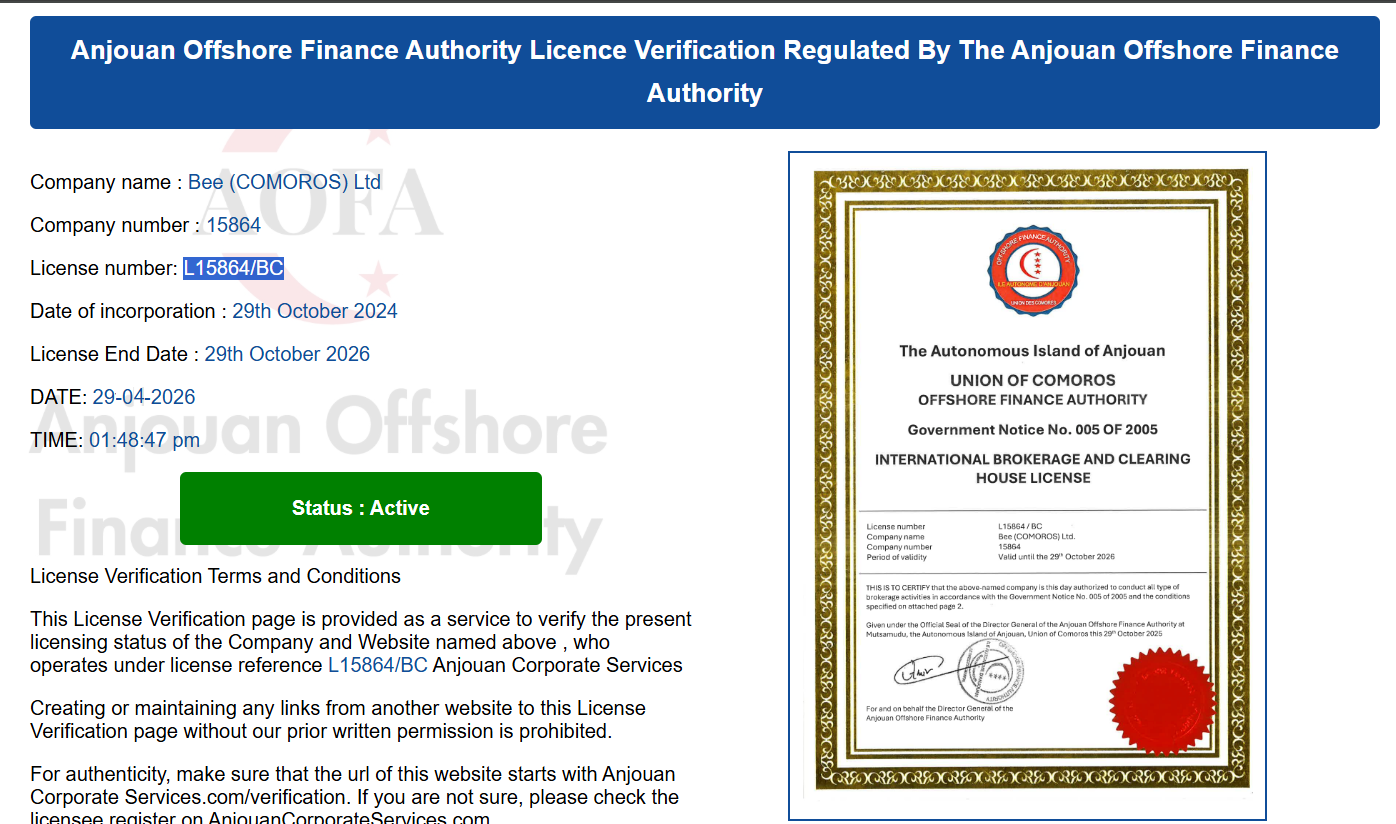
As we can see, the registry of the Anjouan Offshore Finance Authority does indeed contain information confirming that Bee (COMOROS) Ltd holds an active license obtained in 2024 and extended until the end of October 2026. The registration and license numbers published by the broker also match the data available in the registry.
There is, however, one important inconsistency: the regulator’s records do not mention either the trading name BeeMarkets or the website address used by the company. In practice, this means that there is no documentary confirmation that the beemarkets.com platform itself is actually licensed or regulated.
There are strong reasons for such skepticism. The main financial regulator of the Comoros Union is Banque Centrale des Comores, and the regulation of financial services, including Forex/CFD brokers, officially falls under its authority.
At the same time, the Comoros Union effectively functions as a confederation of autonomous islands, including Anjouan. These territories consider themselves entitled to independently manage many state functions, including the creation of their own financial regulators and licensing systems. This is how organizations such as MISA and AOFA emerged. Both issue licenses to brokers and financial services that would have little chance of obtaining authorization from reputable regulators.
In addition, AOFA’s licensing requirements are extremely weak. The regulator does not require physical presence in the jurisdiction, does not impose meaningful standards regarding staff qualifications or professional experience, and sets no serious capital adequacy requirements. Brokers are also not obligated to limit client risks, participate in compensation schemes, or insure their liability. In effect, the regulator has almost entirely abandoned the protection of traders’ rights and interests.
Can a broker operating under such a license truly be considered reliable and fully legitimate? We believe the answer is fairly obvious.
Beemarkets.com History
The broker’s history and online operations also appear fairly straightforward, but some interesting facts remain. For example, information in the regulator’s registry indicates that Bee (COMOROS) Ltd was established and licensed only in late October 2024. However, WHOIS data indicates that the beemarkets.com domain was registered much earlier, in 2017.
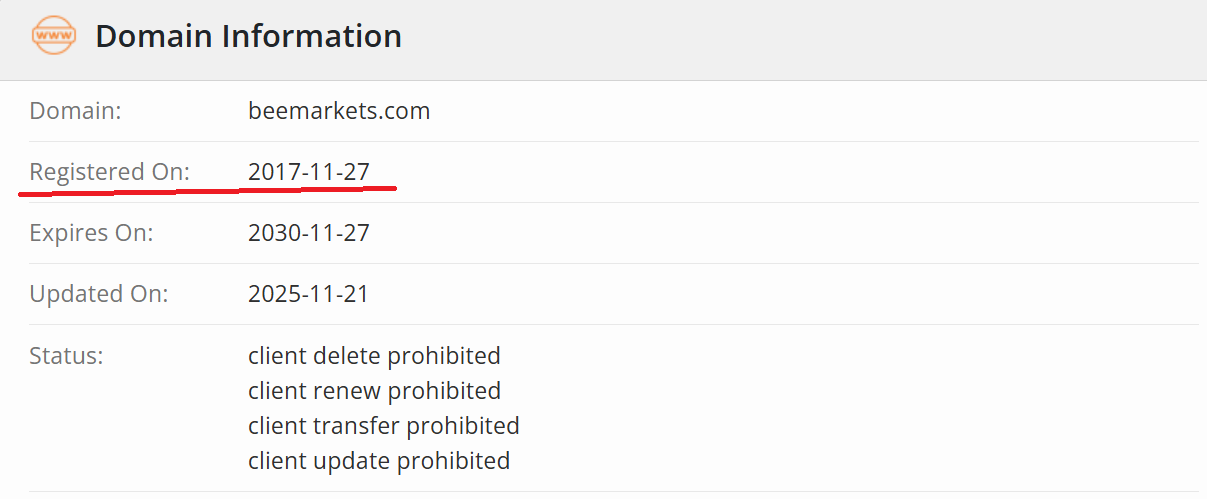
However, the current broker was not the original owner of the domain. Until 2024, it was listed for sale by the registrar HugeDomains. Snapshots from the Wayback Machine show that the trading platform website was deployed on the domain in May 2024. These same snapshots reveal that the project was initially operated by the Australian company that changed its name to BEEMARKETS PTY LTD in 2023 following a change of ownership.
This Australian entity really holds a valid AFSL license issued by ASIC. The license covers spot trading and derivative instruments, including CFDs. However, the strict regulatory requirements imposed by the Australian regulator also significantly limit trading conditions and, consequently, the project’s profit opportunities. Apparently, the owners of BeeMarkets were not satisfied with these restrictions and later transferred control of the website to an offshore company registered in Anjouan.
Still, this transition did not happen immediately. Even in December 2024, archived versions of the site showed BEEMARKETS PTY LTD as the operating company. Only by February 2025 did the platform come under the control of Bee (COMOROS) Ltd. Interestingly, right after this change, the broker did not mention any other affiliated companies at all. The expanded list of supposedly related firms appeared much later.
It turns out that the modern version of BeeMarkets effectively began no earlier than February 2025. For an offshore broker, this is already a considerable period, especially given that its activities are practically unregulated and its license is not recognized internationally.
Interestingly, the broker’s online popularity remains very limited even today. For example, on Trustpilot, the first beemarkets.com review appeared only on August 30, 2025 (about 8 months ago), and since then only 6 reviews have been posted in total. Notably, only 2 users (33%) expressed positive feedback, while the remaining 4 (67%) left strongly negative comments.
On the reputable platform Myfxbook, 9 users submitted ratings, and the resulting score of the project turned out to be relatively high (4.9 out of 5). However, from the content of these posts, it is easy to conclude that the platform administration may be artificially shaping a positive image of BeeMarkets by ordering and paying for favorable comments.
We were also surprised by the relatively high scoring of 6.6 out of 10 on WikiFX. This is likely due to the influence of the ASIC license listed in the profile. At the same time, the platform still includes a warning about high risks when dealing with this broker, and such a disclaimer is clearly not without reason.
Due Diligence: Onboarding & Funding
We have established that the platform operates under a company with official registration and a license, albeit offshore. The next step is to examine how the registration process is organized and what users may encounter in the personal account area.
Becoming a BeeMarkets client is extremely simple: the broker requires minimal personal data during registration:
- Email address or phone number (verification is required via a code sent to the provided contact details).
- Full name of the user.
After verifying contact details and completing the form, the client receives an active account with full access to the personal dashboard. Immediate verification is not required: users can deposit funds and start trading without submitting identity documents.
The platform also does not properly disclose non-trading operation conditions, aside from general promises of convenience, zero additional fees, and support for 7 payment channels plus cryptocurrency transactions. In practice, however, many of these options are not implemented in the client area: users are only able to fund accounts via cards and cryptocurrencies.
We can say that such practices are commonly seen in scam-related projects. Why a supposedly licensed broker like BeeMarkets follows this approach is difficult to explain.
BeeMarkets Conditions and Manipulations
In some aspects, the broker stands out positively compared to similar projects. This mainly concerns disclosure of trading conditions. On the Market section pages, the company provides tables specifying for each trading instrument:
- Maximum leverage.
- Average spread.
- Trading commission per 1 standard lot per side.
- Standard lot size.
If a trader is looking for precise cost information, it can also be found on the Spread and Commission pages in the Trade section. In this regard, BeeMarkets publishes more detailed trading parameters than even some well-established licensed brokers operating in the industry for decades.
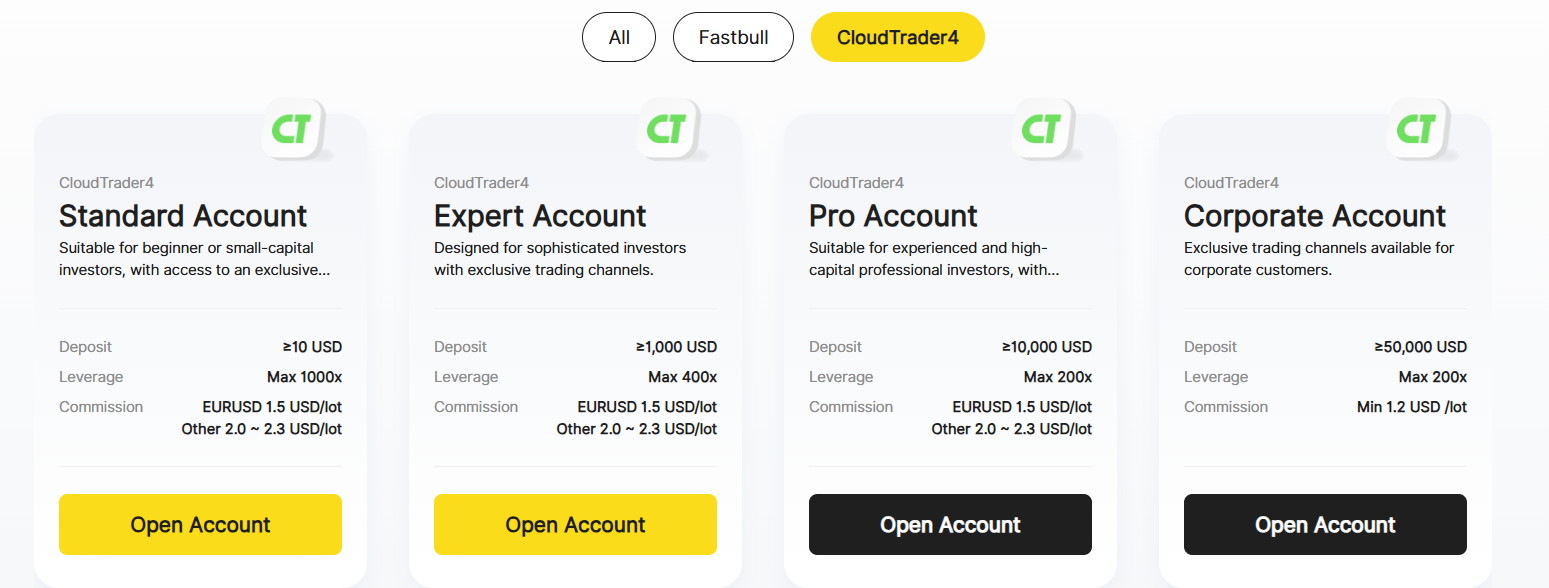
In total, the company offers 8 account types for registered users, 4 for each trading platform: FastBull Trader 4 and CloudTrader 4. Since there are no significant differences between them, we can essentially consider 4 main account types:
- Standard, with a minimum deposit of $10 and maximum leverage of 1:1000.
- Expert, with an entry threshold of $1,000 and reduced leverage of 1:400.
- PRO, with a starting balance of $10,000 and leverage up to 1:200.
- Corporate, with conditions similar to PRO but a minimum balance of $50,000.
Other conditions are identical across all account types: StopOut level is set at 50%, pending orders can be placed as close as 0.1 point from the current price, and up to 200 positions can be opened simultaneously.
For offshore brokers, such a detailed disclosure of trading conditions is not typical. However, it is still too early to praise BeeMarkets for transparency or reliability.
Let us explain this view with several arguments:
- The vast majority of traders can only use the Standard account. It is opened by default for everyone, while access to higher tiers requires additional conditions. For example, upgrading to the Expert account requires at least 6 months of trading history on Standard or proof of relevant trading experience. Conditions for PRO and Corporate accounts can only be obtained upon request via customer support. We suspect that a questionnaire completed in the client area may also play a role in this process, but this cannot be confirmed.
- Swap rates are not published on the website. Experienced traders know that swaps can form a significant part of trading costs when positions are held overnight. However, the broker has chosen not to disclose this parameter.
- The risk level exceeds acceptable limits. This applies even to PRO and Corporate accounts, where leverage is limited to 1:200. While this may be acceptable for professionals with strong risk management systems, for retail traders, such conditions significantly increase the probability of losing the entire deposit. This risk becomes even more extreme on the Expert account with twice the leverage, and especially on Standard, where leverage reaches 1:1000.
- The trading commission of 1.5 USD per standard lot applies only to a single instrument — EUR/USD. For other instruments, it is 1.3–1.5 times higher.
All of this leads us to the conclusion that the supposedly favorable trading conditions and low costs are nothing more than a marketing trick designed to attract inexperienced traders.BeeMarkets can claim on its homepage that it earns only $3.2 per 1 standard lot (100,000 units of the base asset) while its clients save dozens of dollars per trade.
Beemarkets.com Withdrawal Integrity & Exit Process
We were not able to assess the speed, transparency, or reliability of withdrawal operations. The issue is that without verification in the client area, it is impossible to submit a withdrawal request. Moreover, before completing identity verification, users cannot even view the available payment methods.
The broker also does not provide any withdrawal-related information on its website. There is no dedicated document outlining the rules and conditions for payouts. At the same time, we currently have no evidence suggesting that BeeMarkets delays or blocks withdrawal requests.
Strengths & Weaknesses Analysis
-
The broker lists several companies with official registrations and licenses that allegedly represent the brand in multiple countries. Information about the entity operating the website is confirmed.
-
The minimum deposit is only $10 — an amount accessible to almost any trader.
-
The Anjouan license is not recognized by government authorities, experts, or traders, and does not make the platform’s operations legally robust.
-
Non-trading conditions are completely undisclosed, with cryptocurrencies being the primary funding method.
-
The broker offers extremely high leverage of 1:1000, which turns client risk into an unacceptable level.
-
There are numerous paid positive Tradeel reviews circulating online.
Investment Risk Summary
The findings of our BeeMarkets analysis show that the broker does have an official registration and a license. However, it is issued by an unrecognized regulator from Anjouan, which does not make the platform trustworthy in practice. In addition, there are several other reasons not to recommend this company: hidden non-trading conditions, excessively high leverage, and paid reviews on reputable platforms.



Even if BeeMarkets’ service level is up to par (and it leaves much to be desired), no one will ever make any money there. Making a profit is a solvable goal, but you still need to withdraw it somehow. I wanted to receive money via bank transfer, but they refused. They said I should receive it in cryptocurrency. That’s not profitable for me, but no one offers any other options. I don’t like this approach!