
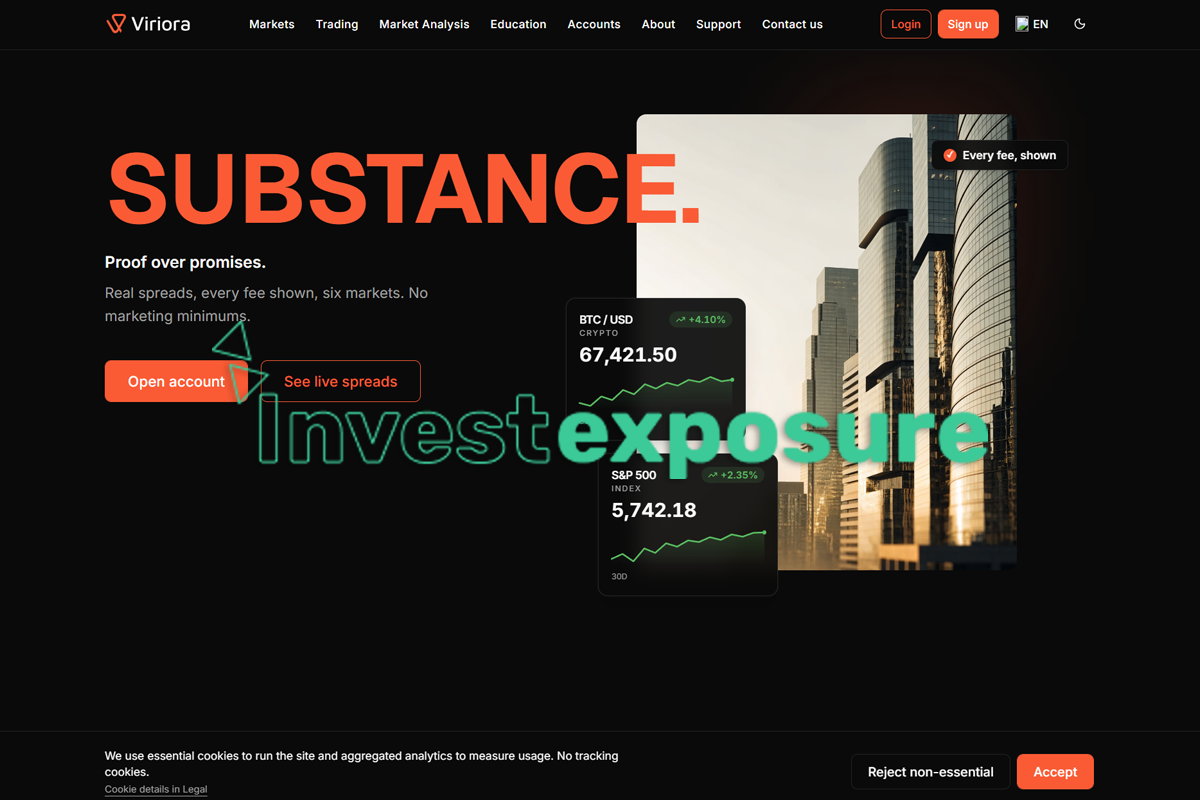
The company presents itself as a Panama-licensed broker “operating since 2021”, yet its domain was registered only in April 2026. Four years of history cannot sit on a three-month-old website, and with no verifiable client feedback anywhere, this Viriora review sets out to check the license, the addresses, and the people behind it for ourselves.
Viriora Quick Card
| Investigation Date | 14/07/2026 |
| Active Website | https://viriora.com |
| Domain Age | Since 23/04/2026 |
| Brand Name | Viriora |
| Operating Entity | Finco Group LLC |
| Stated Jurisdiction | Republic of Panama |
| Blacklist Status | Not found |
| License Status | Fake |
| License Number | No license |
| Office Address | Central street, Kunaisa bldg, Nura Wala Morti, Kuna de Wargandi territory, Republic of Panama |
| Phone Number | +41 71 779 32 45 |
| Support Email | support@viriora.com |
| Quick Contacts | Not provided |
| Company Activities | Brokerage |
| Investing Terms | $5,000 |
| Risk Assessment | Scam |
Let’s Identify the Company’s Background
On paper, the broker is a multi-asset CFD provider, offering forex, stocks, indices, commodities, crypto, and ETFs through the viriora.com website — and offering leveraged products to retail clients is a regulated activity, not an ordinary online business. That means one testable requirement above all: a real license from a competent regulator, with the company listed in that regulator’s public register under the exact legal entity named on the site. Viriora’s footer claims Finco Group LLC is “authorized and regulated” by Panama’s SMV under a specific license number — so let’s check it against the SMV register.
Viriora Jurisdiction and Regulation
By its own disclosure, the broker is operated by Finco Group LLC, a company said to be incorporated in the Republic of Panama and regulated there by the Superintendencia del Mercado de Valores (SMV). Panama is worth understanding before we go further: it does license brokers, but only as a Casa de Valores, and for retail forex it is a weak, offshore-grade regime — even a genuine Panama license carries little of the client protection you would get from the FCA, CySEC, or ASIC. So the best case here was never strong. The question is whether even that best case is real.
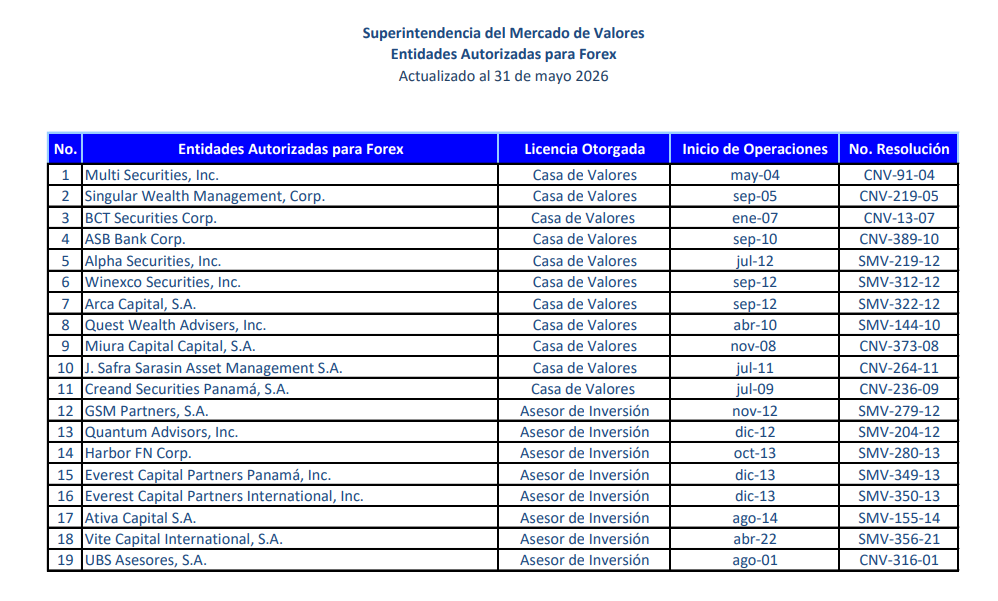
It is not. We searched the SMV’s public register of licensed Casas de Valores, and neither Finco Group LLC nor Viriora appears anywhere on it. Three details make the claim collapse on inspection:
- The number doesn’t fit. Real SMV licenses are issued by resolution, formatted like SMV-202-26. Broker’s “Investment Business License Number 2026117774167DAA” matches nothing Panama issues — and “Investment Business License” is not even SMV terminology.
- The legal form is wrong. Panamanian brokers are incorporated as S.A., Inc., or S.R.L. An “LLC” is not a corporate form the SMV licenses.
- The regulator is unnamed by them in any verifiable way — no resolution, no register entry, no cross-reference that survives a lookup.
Viriora.com History
The “Corporate facts” page states the company was founded in 2021, and the About page repeats that it has been “operating from the Republic of Panama since 2021”. A four-year track record is exactly the kind of reassurance a cautious trader looks for. The problem is that it isn’t true.
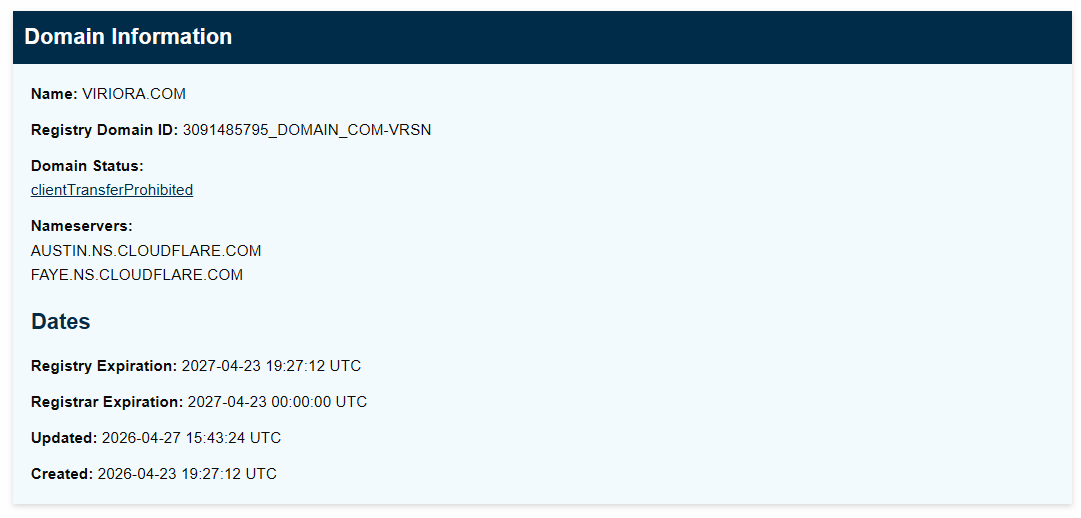
We pulled the WHOIS record for the domain, and it tells a very different story:
- Registered on: 23 April 2026 — barely three months before this viriora.com review.
- Expires on: 23 April 2027 — booked for a single year, the shortest term available.
Due Diligence: Onboarding & Funding
We opened an account to see the process from the inside, and the most revealing thing about the Viriora trading platform is how little it asks for. Registration is two short steps — an email with a password, then a name, surname, phone, and date of birth. Tick two boxes, click Register, and you’re in.

What’s absent at this stage matters more than what’s present:
- No email confirmation — the address is never verified.
- No phone or SMS check — the number is never confirmed.
- No two-factor authentication was offered anywhere, then or afterward.
A platform that never verifies the email, the phone, or the identity of the person opening an account is not protecting anyone — it is stripping out every barrier that stands between a visitor and a funded balance.
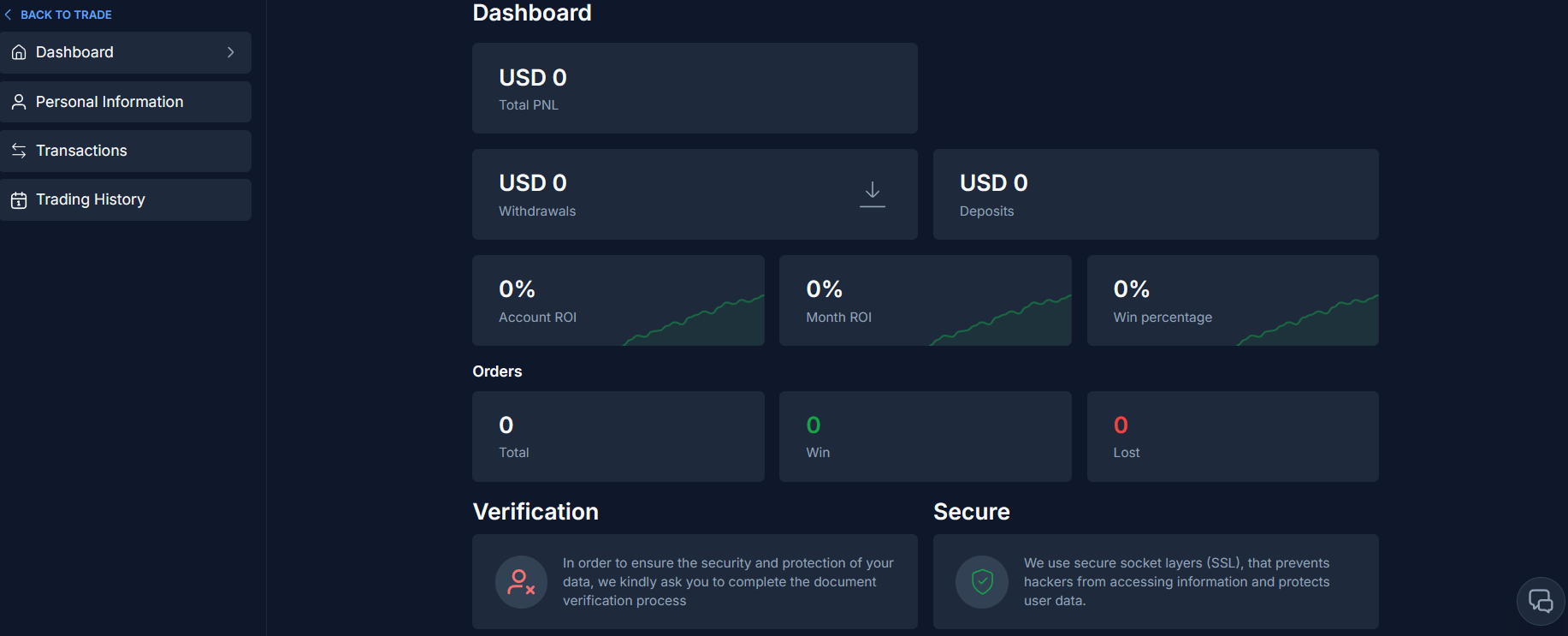
Then there’s KYC. On a legitimate broker, identity checks are mandatory before the first deposit — that is the entire point of them. Here it works the other way around: after sign-up, the dashboard shows only a soft prompt — “we kindly ask you to complete the document verification process” — with no requirement, no deadline, and no accepted-document list. There is nothing stating where those files go or who processes them, which, for an unregulated entity, is its own risk: your passport and proof of address could be handed to any third party without recourse. Verification that is optional at deposit but conveniently remembered at withdrawal is not a security measure — it’s a withdrawal brake.
Funding follows the same pattern as everything else: the FAQ makes confident promises, the cabinet delivers none of them. Viriora advertises SEPA transfers, cards and “vetted e-wallets”, same-day withdrawals, zero fees, and a source-account rule framed around “anti-money-laundering rules” — reassuring language that falls apart on two points. It’s an FAQ, not a real payments policy: four collapsible one-liners, with no named processor, no safeguarding bank, and no binding terms. And that EU vocabulary — SEPA, safeguarding, AML — belongs to authorized European institutions, not to an offshore Panama entity whose license we’ve already shown to be invented.
More telling, none of it works. The deposit button is unclickable, and there is no verification route at all — no upload field and no document list. Funding that supposedly is instant and fee-free has no mechanism a user can actually operate, which points back to the same channel: money moved manually, over chat, by an “account manager” — off the record, outside any processor’s protection.
Viriora Conditions and Manipulations
Begin with the most basic question a broker must answer — how your order actually reaches the market — because the broker never does. The site headlines “typical” spreads — 0.6 pips on EUR/USD, 0.5% on BTC — but names no execution model, no liquidity providers, and no market makers. A broker that publishes teaser spreads while staying silent on where your orders go is telling you, by omission, that they don’t leave the building. With no liquidity infrastructure behind it — and none is disclosed or, given the invented license, plausible — this is a B-Book/dealing-desk setup: you aren’t trading against the market, you’re trading against Viriora, whose revenue is simply your losses. That single fact reframes every other “condition” on the site.
The tiered accounts sharpen the point. Access, “trading signals”, and a “dedicated portfolio manager” unlock as deposits climb from $5,000 to $250,000, meaning the people advising your trades are paid by the counterparty that profits when those trades fail. On leverage, the firm is quiet, but quiet in a revealing way: a genuinely regulated broker is capped (EU retail sits at 1:30), so any offshore desk that later offers 1:100, 1:500 or more isn’t giving you power — it’s shortening the time it takes to lose the whole balance, which suits a B-Book perfectly.
Viriora.com Withdrawal Integrity & Exit Process
Everything we’ve traced so far points to one bottleneck: the moment a client asks for their money back. The FAQ promises same-day, fee-free withdrawals returned to the source account “to meet anti-money-laundering rules” — but that source-account rule is a double-edged clause. On a real broker it prevents laundering; on an operation with no working verification flow, it becomes the pretext that stalls you — the KYC that was never required at deposit is suddenly demanded before a payout, with the document list and processing standards decided on the spot. The verification quietly skipped on the way in is exactly the gate that closes on the way out.
And there is no clean exit designed into the platform. The cabinet has no functioning withdrawal mechanism any more than it has a working deposit button — funding runs through an “account manager,” so the same person profiting from your losses is the one who controls whether a withdrawal is processed, delayed, or buried under fresh conditions. There is no closure procedure, no complaints channel, and no regulator to appeal to, because the SMV license we checked doesn’t exist. In our opinion, getting money out of the broker is a negotiation you enter from the weaker side — and that, far more than any spread or bonus, is what defines the real cost of dealing with this broker.
Strengths & Weaknesses Analysis
-
Not found.
-
Fabricated regulation.
-
False track record.
-
The business model is 100% B-Book.
-
No real security at onboarding.
Investment Risk Summary
Weighed against every checkpoint that defines a legitimate broker, Viriora fails the only ones that matter — a fabricated license, a false history, and no safe way in or out — so cooperation here — it’s a near-certain loss.





It’s terrible that brokers like these keep popping up almost every single day. After all, there are newcomers to trading who naively believe that companies like this can be trusted. But no – this is an illegal broker created from a ready-made template with the goal of scamming traders out of their money. They have no other objective. So be careful. As an experienced trader, I advise avoiding platforms like this…