

Another scam project is trying to attract traders, or rather, their money, by promising comprehensive education, a unique trading platform, and exceptionally favorable trading conditions. These offers may seem appealing to some. However, the price is always the same: the complete loss of invested funds. For those who have doubts or cannot conduct a thorough analysis on their own, we have carefully examined this company and presented our findings in a detailed Colbari review.
Colbari Quick Card
| Investigation Date | 15/04/2026 |
| Active Website | https://www.colbari.com/ |
| Domain Age | Since 18/09/2025 |
| Brand Name | Colbari |
| Operating Entity | Valor Capital (PTY) Ltd |
| Stated Jurisdiction | South Africa |
| Blacklist Status | Not found |
| License Status | Verified |
| License Number | FSCA No. 51822 |
| Office Address | 1 Edgemere Road Elfindale, Cape Town, 7945, South Africa |
| Phone Number | +27218911885 |
| Support Email | info@colbari.com |
| Quick Contacts | Live chat |
| Company Activities | Brokerage |
| Investing Terms | $250 |
| Risk Assessment | High risk |
Let’s Identify the Company’s Background
For a trader, choosing the right Forex/CFD broker first of all means evaluating the quality of the company’s offerings and the level of trust it inspires. Colbari provides extensive and polished descriptions of its advantages and the benefits clients supposedly receive from working with it. Unfortunately, most of these claims lack specific details — such as figures, dates, and clear characteristics. Therefore, we will begin our assessment with the most critical aspects: registration, licensing, and the project’s online history.
Colbari Jurisdiction and Regulation
The company’s owners seem to believe that a large volume of official information helps the project appear more credible. As a result, they provide potential clients with not only essential details but also some unnecessary ones.
The key information of interest includes:
- The Colbari brand is owned and operated by Valor Capital (PTY) Ltd.
- The company is registered in South Africa and authorized as an FSP by the local financial regulator, the Financial Sector Conduct Authority (FSCA).
Additional information that can be noted but is less relevant:
- Valor Capital (PTY) Ltd shares common shareholders with the Greek firm Value Bridge Single Member Investment Services S.A., which holds a license from the Hellenic Capital Market Commission.
- The broker’s payment agent is a UK-based company, Dunfield Ltd.
We will focus only on the information directly related to the platform’s operations. Accordingly, we verified the official data of the South African entity.
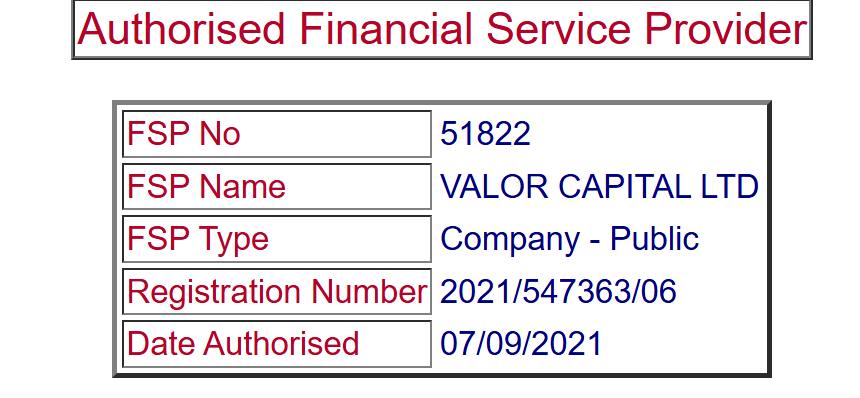
As shown in the FSCA registry, there is indeed a record of an authorized Financial Service Provider (FSP) under the name Valor Capital Ltd. The company was registered in June 2021 and obtained its license on September 7, 2021. The list of permitted activities is quite broad, covering nearly all financial services — from insurance and pension fund management to operations with currencies, securities, and derivatives. All of these fall under Category I – Advising and Executing. At first glance, this suggests that the company has sufficient authorization to provide brokerage services in both stock and Forex/CFD markets.
However, this conclusion would only be valid for those unfamiliar with the current regulatory landscape in South Africa. In 2018, with full implementation expected by 2024–2025, the updated Financial Markets Act Regulations and Conduct Standard 1 of 2018 introduced new requirements. According to these rules, dealers and market makers working with OTC derivatives (which include CFDs, including crypto CFDs) must also obtain an ODP (Over-the-Counter Derivative Provider) license in addition to FSP authorization. Furthermore, authorities plan to tighten regulatory oversight starting in 2026.
It is possible that the platform does not serve clients within South Africa and instead targets regions where foreign brokers can operate without local registration or licensing. However, even for clients in such jurisdictions, it is important to understand that trading with this broker is done entirely at one’s own risk, with no real protection of traders’ rights or interests.
Colbari.com History
The broker’s history turned out to be even more intriguing. As we have seen, the company was registered and obtained its license in 2021. However, the domain colbari.com was registered much later — on September 18, 2025.
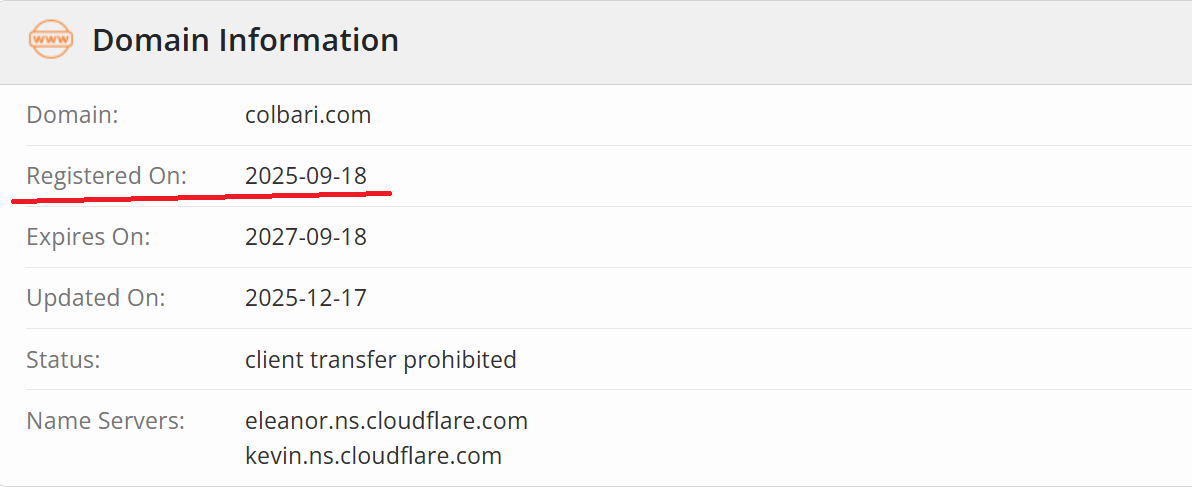
This raises an obvious question: did the firm really wait more than four years before deciding to start offering brokerage services online? We have another assumption: the project’s owners likely acquired an existing company along with its license, which allows them to present the platform as a legally operating entity under the supervision of a local regulator.
Such a move would be quite rational. Obtaining a new license from the South African regulator today, especially not only an FSP but also an ODP license — requires meeting fairly strict requirements, including maintaining share capital of approximately €750,000 to €1 million. It is unlikely that a lower-tier broker could afford such expenses.
Another argument supporting this version is the official website of Valor Capital (PTY) Ltd (https://www.valorcapitalltd.com/). According to WHOIS data, its domain was registered even later than the broker’s main domain — on October 8, 2025. It might be possible to believe that the company did not provide online brokerage services for several years, but the idea that it delayed creating its own website for four years seems highly implausible. On the other hand, the actions of the project’s owners appear logical: the website of the legal entity managing the broker contains direct links to the broker’s official web resource.
The fact that the broker itself is relatively new is also confirmed by online reviews. For example, the first comment about colbari.com on Trustpilot is dated January 16, 2026. Notably, within just three months, the platform accumulated 15 reviews with a ratio of 4:1 (80% negative and 20% positive). In our opinion, this does not align with the behavior of a licensed and trustworthy broker. This impression is further reinforced by opinions on social media, where Colbari is often described as a typical scam.
Due Diligence: Onboarding & Funding
It seems that Colbari’s staff decided potential clients might get bored, so they turned the otherwise simple registration process into a rather complicated quest.
Its essence is to guess which countries are actually allowed to register. The broker provides an extensive list of restricted jurisdictions, including the EU and EEA, the USA, Canada, and, as vaguely stated by the content managers, “some other regions.” As a result, when attempting to register from different locations, the most common server response is an apology stating that clients from the selected country are not serviced.
It remains unclear whether this is a temporary technical issue with the website and user area or a deliberately implemented restriction. We have seen cases where self-registration is impossible, and support staff manually create accounts while simultaneously pressuring users to deposit as much money as possible. It is possible that Colbari follows a similar model. In any case, we were unable to create a functioning account.
According to a document titled General Fees, the company uses bank transfers, debit/credit cards, and certain electronic payment systems for financial operations. However, no detailed information is provided regarding deposit conditions: there are no stated limits, no processing times, and no clarity on how quickly funds are credited. The only information disclosed is that deposits are free of charge, although traders should keep in mind that payment system fees may still apply.
Prima Capital Conditions and Manipulations
Overall, everything we have learned about Colbari so far is disappointing. There was some hope that trading conditions might improve the overall impression, but that did not happen.
To begin with, the descriptions of available markets in the Markets section are extremely superficial. While we did not expect anything groundbreaking, a couple of short paragraphs per asset class and a vague list of supposed advantages are clearly insufficient. Moreover, the broker does not even provide a list of tradable instruments. Naturally, there are no contract specifications either.
As a result, the only available source of information about trading conditions is the account types. However, anyone expecting to find comprehensive details there will be disappointed.
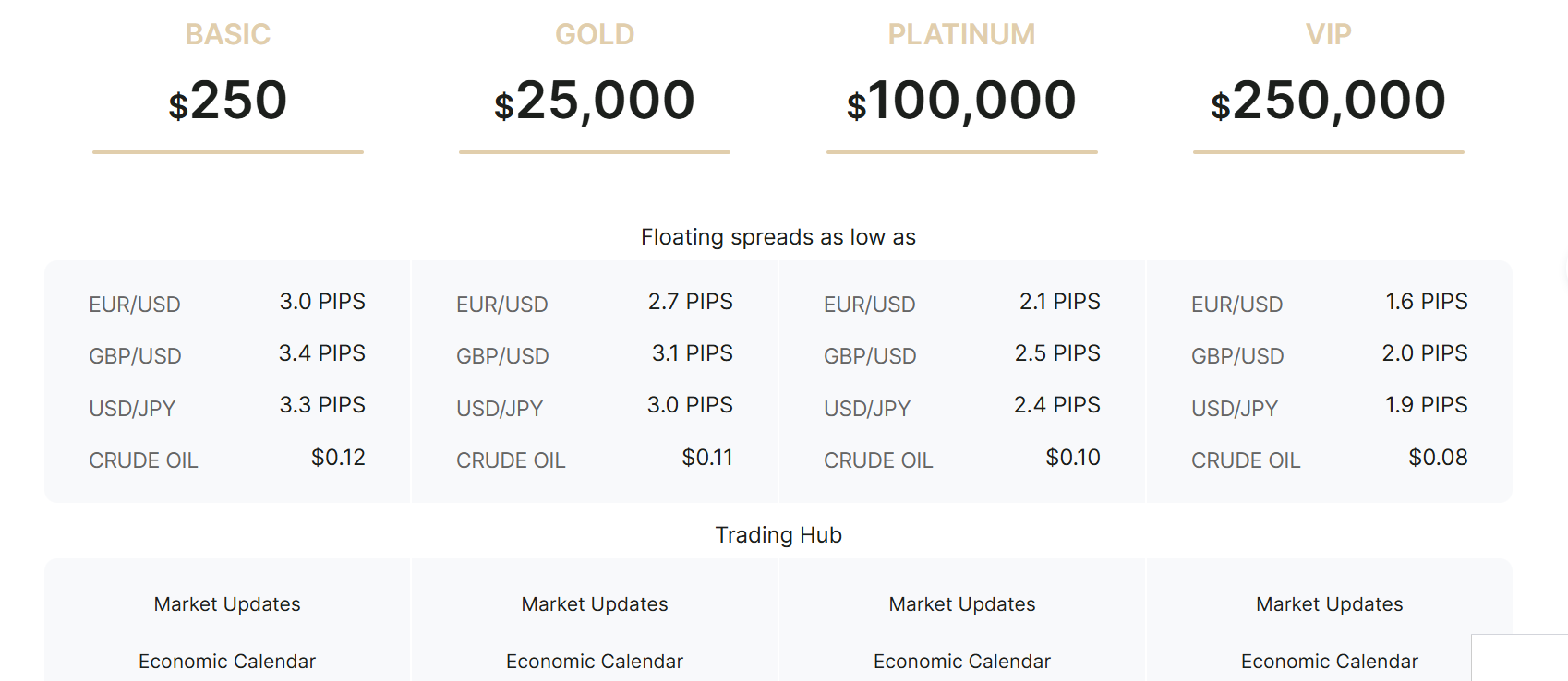
As we can see, users are offered four account types:
- Basic, with a minimum deposit of $250.
- Gold, requiring a starting amount of $25,000.
- Platinum, with a deposit from $100,000.
- VIP, with a minimum balance of $250,000.
The maximum leverage for all account types is 1:400. According to the website, the only difference lies in spreads: the minimum spread is 3 pips for Basic, 2.7 pips for Gold, and 2.1 and 1.6 pips for Platinum and VIP, respectively.
Even based on this limited information, several conclusions can be drawn:
- The company shows no concern for client risk, as leverage of 1:400 pushes risk levels far beyond acceptable limits. Since the broker does not distinguish between retail and professional traders and offers identical conditions to all, the likelihood of beginners losing their deposits within the first few days approaches 100%. The reasoning behind this approach is quite clear: the company acts as the counterparty to client trades, meaning user losses translate directly into its profit. Naturally, it has no incentive to miss the opportunity to absorb client funds without any apparent violation of regulations.
- Spreads, especially on lower-tier accounts, are significantly higher than those offered by most modern brokers. For example, on the Basic account, the EUR/USD spread is nearly four times the industry average. Even on the VIP account, which requires a $250,000 deposit, spreads are still almost twice as high.
- We also observe a standard scam tactic: more favorable conditions are only available with higher deposits. To achieve just a 10% improvement compared to Basic, a trader must deposit 100 times more, while a 50% reduction requires a 1,000-fold increase in capital.
In our view, Colbari’s intention to capture as much client capital as possible is quite evident. Moreover, the company can achieve this without any explicit legal violations simply by offering such trading conditions.
Colbari.com Withdrawal Integrity & Exit Process
We have already mentioned the limited information provided regarding financial transactions. In the General Fees document, we found the following withdrawal fees charged by the broker:
- Bank cards — 3.5%.
- Bank transfers — 30 units of the transaction currency (USD/EUR/GBP/CHF).
- E-wallets — 1.5% to 4.5%.
At the same time, the company reserves the right to increase the fee up to €80 (or equivalent) in certain cases, such as low account activity. Considering that most licensed brokers process withdrawals free of charge (passing only payment system fees to clients), Colbari’s pricing policy appears excessive. However, this project also involves a payment agent, which likely explains the additional costs.
That said, the company presents what it describes as a generous offer by allowing a limited number of free withdrawals depending on account type:
- Basic — once.
- Gold — once per month.
- Platinum — three times per month.
- VIP — unlimited.
Strengths & Weaknesses Analysis
-
The entry threshold is relatively low — a $250 deposit is affordable for most traders.
-
The broker is officially registered and operates under a license, although it does not comply with recent regulatory changes in South Africa.
-
The company is authorized as an FSP but does not hold an ODP (Over-the-Counter Derivative Provider) license, which is currently mandatory in South Africa for dealers and market makers working with CFD instruments.
-
Maximum leverage of 1:400 is excessively high for retail traders, especially beginners, making the associated risks unacceptable.
-
Trading conditions can hardly be considered competitive, as they are significantly worse than those offered by most licensed brokers.
-
The company provides very limited information regarding non-trading operations.
-
There are still relatively few reviews online, but the overwhelming majority of them are negative.
Investment Risk Summary
Based on the findings presented in this Colbari review, we can confidently conclude that the broker shows clear signs of being a scam. Although it provides information about registration and licensing, we have strong reasons to doubt that these credentials are genuinely related to the platform. Additional concerns arise from the poor quality of the official website, the lack of transparency regarding non-trading conditions, and the unfavorable trading terms offered to clients. At the same time, while the number of online reviews remains limited, most of them are negative and indicate that the company fails to process withdrawals.





Colbari is a scam! I deposited $25,000 because they claimed to be registered, licensed, and promised assistance. But then the platform started freezing, my account manager disappeared, and all trades went into the red. I got worried and started reading reviews — I was shocked. There aren’t many of them, but there’s plenty of negative feedback! I honestly don’t know what to do now. There’s no money left in my account, and I doubt even lawyers will be able to help. After all, I made the deposit myself and technically traded on my own
This is terrible: Colbari is full of scammers! Right after I made a deposit, they charged me for “insurance” that I had never heard of (there is no mention of it anywhere on the site). Then the trading platform started freezing, and I began to question whether it was even possible to trade with this broker. Eventually, I decided to withdraw at least the remaining $5,000. I submitted a request, but first they asked me to go through verification again (it took almost 8 days), then the request stayed pending for nearly a week until I received an email saying I couldn’t withdraw without paying taxes. I argued with support for almost a month, and one day my account balance simply dropped to zero. They told me it was due to account inactivity. These are scammers who will never return my money.