

An FCA firm reference number, an address inside London’s Gherkin tower, and $850 billion in traded volume — the broker opens with the credentials of a serious institution. However, you shouldn’t take anyone’s word for it on the internet. This Stanford Capital review lays out what each claim turns into once you check it.
Stanford Capital Quick Card
| Investigation Date | 05/08/2026 |
| Active Website | https://www.stanford-capital.com |
| Domain Age | Since 19/07/2025 |
| Brand Name | Stanford Capital |
| Operating Entity | Not disclosed |
| Stated Jurisdiction | United Kingdom |
| Blacklist Status | Not found |
| License Status | Cloned |
| License Number | No license |
| Office Address | 30 St Mary Axe (The Gherkin), EC3A 8BF, London, UK |
| Phone Number | – |
| Support Email | support@stanford-capital.com |
| Quick Contacts | Live chat |
| Company Activities | Brokerage |
| Investing Terms | $10,000 |
| Risk Assessment | Scam |
Let’s Identify the Company’s Background
Stanford Capital presents itself as a multi-asset brokerage, offering CFDs on forex, stocks, commodities, and crypto, plus discretionary-style services such as personal relationship managers and retirement fund investing. Every one of those activities is regulated everywhere it is legally carried out: a firm needs authorization from a financial regulator, a disclosed legal entity behind it, and segregated client accounts at a real bank. The broker claims exactly that — FCA authorization, firm reference 833652, a London registered office and segregated funds. Each of those four claims is verifiable in a public register, so we checked all of them one by one.
Stanford Capital Jurisdiction and Regulation
The Regulation page is where the project makes its boldest statements, so we started there. It declares the company “authorized and regulated by the Financial Conduct Authority”, lists Firm Reference Number 833652, Company Registration 03909628, a registered office at 30 St Mary Axe, EC3A 8BF, London, and adds permissions for cryptocurrency services under the Money Laundering Regulations 2017 plus electronic money and payment services. On paper, that is a serious British setup. It seems like we’re dealing with a serious organization, but that’s not the case.
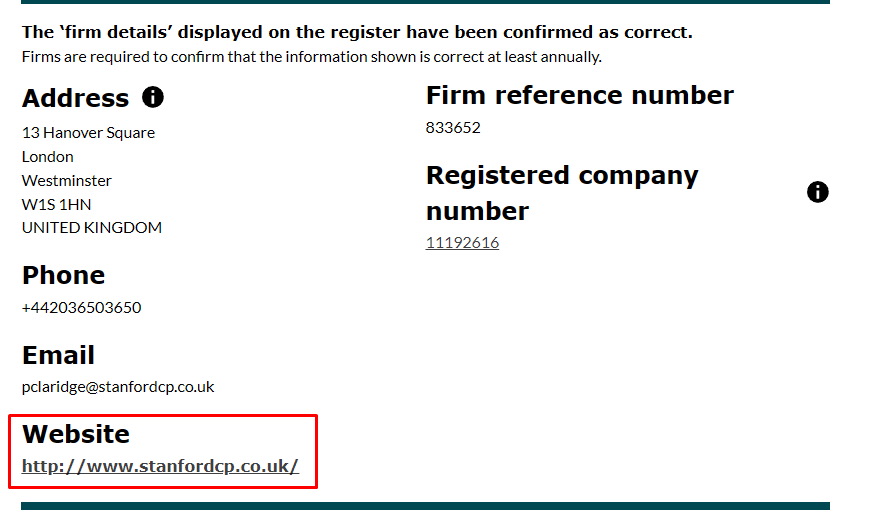
The FCA reference number is real, but it does not belong to this website. FRN 833652 is registered to Stanford Capital Partners Limited, authorized since 30 August 2019 and based at 13 Hanover Square, London W1S 1HN —you can verify it on the FCA Register. Note the address: the register says Hanover Square, the website says the Gherkin.
There’s also an interesting point regarding the registration number. Registration 03909628 belongs to AUTOTRADER LIMITED — a car classifieds publisher in Manchester, incorporated in January 2000 — and anyone can confirm it atCompanies House in seconds. Whoever assembled the page needed a plausible eight-digit string and evidently assumed nobody would look. That single detail tells us more about the operation’s diligence than any marketing copy: they did not even source their fake credentials from the same industry.

Stanford-capital.com History
A broker’s age is one of the few facts that cannot be negotiated, and registrar records settle it in seconds. In this stanford-capital.com review, the lookup returns a single decisive line: the domain was created on 18 July 2025 and paid up only to July 2027.

That date dismantles the homepage. A platform live for roughly 12 months claims 150 million executed trades, 2.5 million users across 180 countries, and an award for “best trading platform 2024” — a distinction granted before the domain existed, by an organization the site never names. The 2024 copyright line in the Stanford Capital footer betrays the same recycled template. And a broker with millions of clients would generate complaints, forum threads, and app-store listings within months; we found no reviews, no discussion, no mentions outside the domain itself.
Due Diligence: Onboarding & Funding
The registration form asks for first and last name, email, phone number, and country — and then, on the very same screen, for the initial deposit and full card details: card number, expiry date, CVV, and cardholder name. A regulated broker does not collect payment card data on a signup form; it creates an account first, verifies the client, and only then routes the payment through a licensed processor’s own checkout. Here, there is no processor branding, no acquirer named, and no card scheme logos — just input fields on Stanford Capital’s own page and a reassuring line about 256-bit SSL and PCI DSS compliance, neither of which is backed by a certificate reference, an assessor name, or an Attestation of Compliance anyone could request.

A KYC Policy sits in the Legal menu, and the FAQ states that identification documents are required, yet the funding form demands card data before a single document is requested. Legitimate platforms run verification before accepting money, precisely because that is what AML rules require; projects that postpone KYC until the first withdrawal request do so because the verification stage is where the refusals happen — suddenly the documents are unreadable, the selfie does not match, or the utility bill is too old.
Stanford Capital Conditions and Manipulations
Before assessing how a client could be harmed here, it is worth noting what the site never publishes. There is no spread table, no commission schedule, no swap or overnight financing rates, no instrument list, no margin call and stop-out levels, and no execution policy. What replaces them is comparative language with nothing to compare against: “moderate spreads” on the Basic account, “tighter spreads” on Plus, “up to 10% lower pricing”, “up to 30% lower prices”, and “negotiable spreads and commissions” for Executive clients.
The business model rests on a conflict of interest the site never discloses. No liquidity providers, prime brokers, or execution venues are named anywhere, and no order execution policy exists — meaning client orders are not routed to the market at all, but processed internally against the platform itself. In this pure B-Book arrangement, the broker is the counterparty to every trade, so a client’s loss is not a market outcome but the company’s direct revenue. There is no real liquidity behind the quotes, no external price feed to verify them against, and no third-party terminal that could expose a discrepancy: spreads, slippage, stop-out levels, and the balance on screen are all set by the same party that profits when the account goes to zero.
Stanford-capital.com Withdrawal Integrity & Exit Process
A major red flag with a broker is the absence of key information. Stanford Capital doesn’t provide much relevant information:
- No Withdrawal Policy and no Terms and Conditions — the Legal menu holds four short pages, and none of them covers payouts.
- No list of supported methods, so it is impossible to know whether funds return by card, by bank transfer, or by crypto to an address the operator nominates.
- No minimum or maximum withdrawal amount.
- No processing timeframe, in hours, days, or business days,
- No withdrawal commission, conversion spread, or inactivity fee disclosed anywhere.
- No statement of the card-refund rule that every genuine processor enforces, under which deposits must first be returned to the originating card.
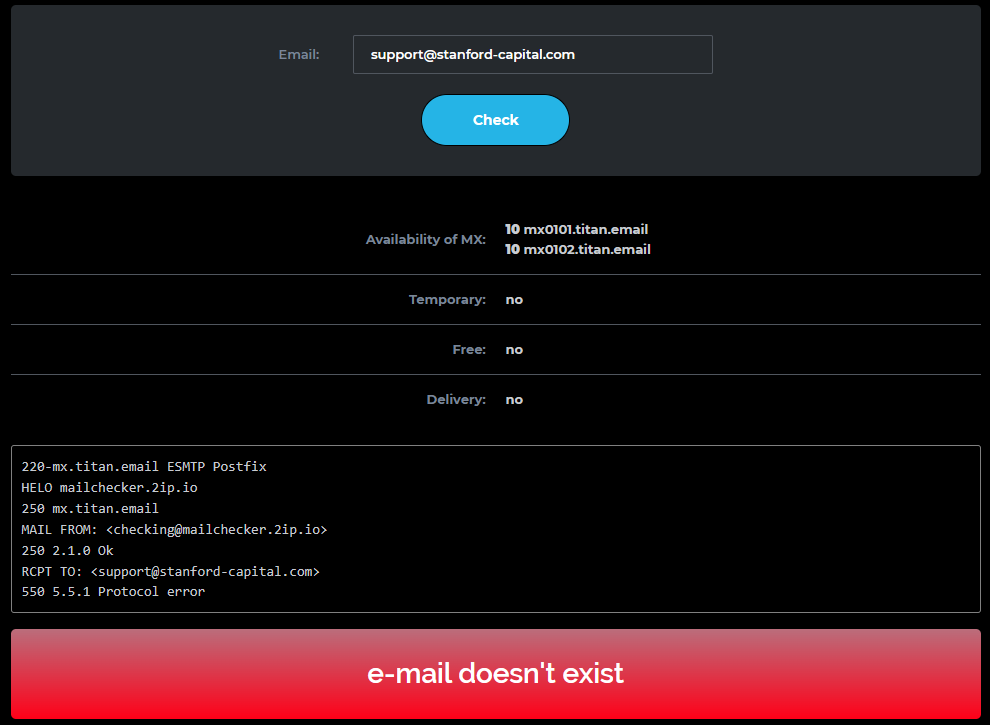
If a client wants to contact company representatives, they will not be able to do so. The available channels are: one email address. There’s also an online chat, but it’s for those who have managed to register an account. There are also social media logos, but they’re just icons.
Strengths & Weaknesses Analysis
-
Not found.
-
FCA license number belongs elsewhere.
-
No legal entity disclosed anywhere.
-
Domain created only in 2025.
-
Fake contacts.
-
Trading conditions entirely undisclosed.
Investment Risk Summary
Honest brokers make themselves easy to verify; this one made itself easy to verify by accident, and every check came back negative. What we found is a clone of an authorized London firm, running on borrowed numbers, targeting deposits from $10,000 to over a million with no mechanism to return any of them. In our opinion, the only rational decision regarding Stanford Capital is to keep your money and report the site to your national regulator.




I was lucky to stop in time and not register an account here. I really thought and believed that it was a British brokerage company operating under the supervision of the FCA. However, then I read a few reviews that laid out clearly and plainly why it’s a scam and a fake. Thank you so much! You’re helping people hold on to their money!
What are the trading conditions here? Is it really that hard to write them down? However, what’s even funnier is that it’s impossible to reach the scammers at Stanford Capital. THEY’VE GOT A FAKE EMAIL, HAHAHAHA. It’s so stupid and funny