
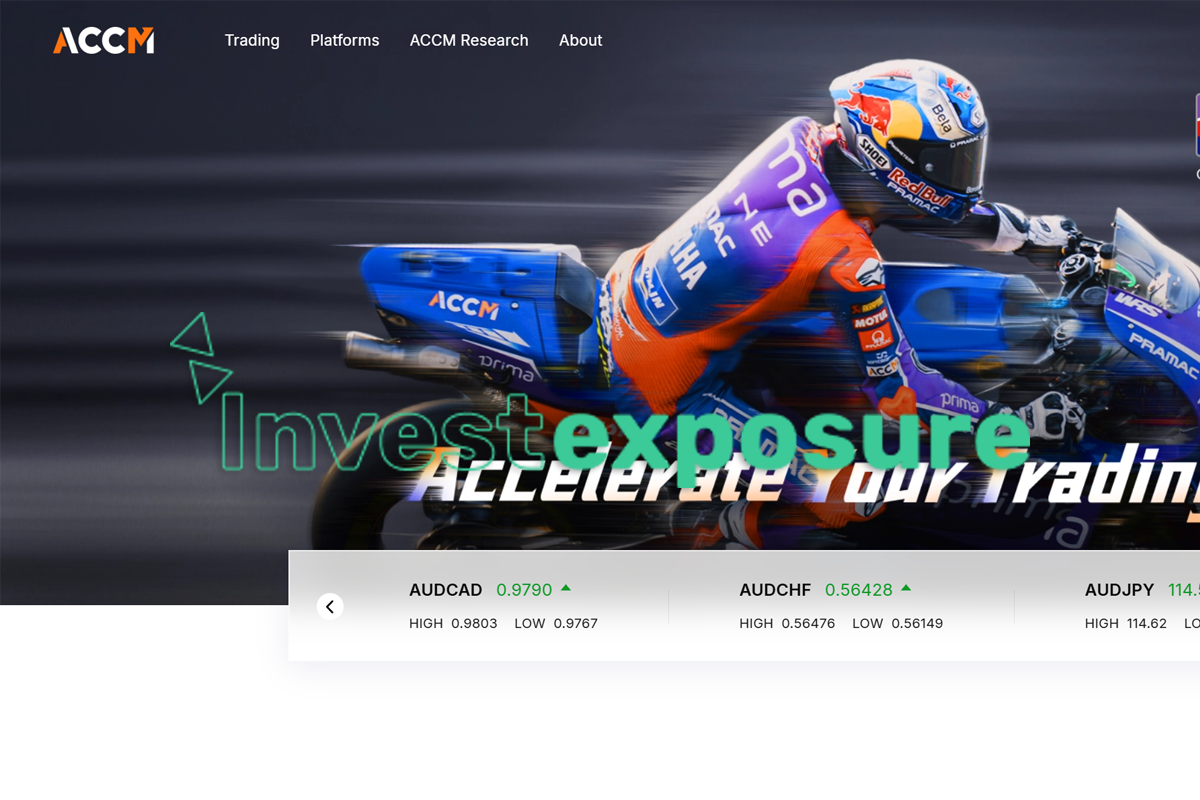
The company markets itself as a “globally leading CFDs broker since 2007” with over 1 million clients, a flashy MotoGP partnership, and an ASIC badge on the homepage — yet the site operator turns out to be a Vanuatu-registered entity that openly excludes residents of every Tier-1 jurisdiction it implies it’s regulated in. In this ACCM review, we’ll separate what’s legal, what’s marketing theater, and what looks suspiciously close to patterns we usually see in offshore brokers operating near the line between aggressive practices and outright scam.
ACCM Quick Card
| Investigation Date | 27/04/2026 |
| Active Website | https://accmfx.com |
| Domain Age | 02/10/2024 |
| Brand Name | ACCM |
| Operating Entity | ACCM Global Limited |
| Stated Jurisdiction | Republic of Vanuatu |
| Blacklist Status | Not found |
| License Status | Verified |
| License Number | VFSC SDL № 700597, ASIC № 308159, SFSA № SD198, FSCA № 54284 |
| Office Address | Malapoa Estate, Port Vila, Republic of Vanuatu |
| Phone Number | – |
| Support Email | cs@accmfx.com |
| Quick Contacts | Live chat/Social profiles |
| Company Activities | Brokerage |
| Investing Terms | $500 |
| Risk Assessment | High |
Let’s Identify the Company’s Background
A broker that asks clients to deposit real money and trade leveraged CFDs isn’t just a website with charts — it’s a financial counterparty that should hold a verifiable license from a competent regulator, operate through a clearly identifiable legal entity, segregate client funds, and disclose who actually stands behind the trades. These aren’t optional niceties; they are the baseline that separates a legitimate broker from a marketing wrapper around an offshore shell.
ACCM ticks some of these boxes loudly, and others very quietly, so in the next sections we’ll go through the corporate structure, the licenses, the regulatory reach, and the disclosures one by one — checking each claim against the relevant public register rather than taking the website at its word.
ACCM Jurisdiction and Regulation
The platform operates as a multi-entity corporate group spread across four jurisdictions, which is one of the most common patterns we see in CFD brokers playing the regulatory arbitrage game. Each entity holds its own license, but only one of them — the offshore one — actually contracts with clients who sign up through accmfx.com. The website itself confirms this in its legal disclaimer: “This website is operated by ACCM Global Limited, incorporated in the Republic of Vanuatu… All financial services provided via this website are offered by ACCM Global Limited”.
Here’s the full corporate map as disclosed by the broker, with cross-references to the public registers we checked:
- ACCM Global Limited — the actual contractual counterparty for retail clients of accmfx.com. Registered in Port Vila, Republic of Vanuatu, regulated by the VFSC under license SDL № 700597. You can verify this entry on theVFSC public register.
- ACCM Prime Pty Ltd — registered in Australia. Holds AFSL № 308159 issued by ASIC. Verifiable on ASIC Connect. This is the entity whose name and license number appear most prominently in ACCM’s marketing — yet it does not service the website’s retail clients.
- ACCM INTL LIMITED — registered in Mahe, Seychelles, regulated by the FSA (Financial Services Authority Seychelles) under license № SD198. Verifiable on theFSA Seychelles register.
- ACCM Global (Pty) Ltd — registered in South Africa. Holds FSP № 54284 issued by the FSCA. Verifiable on theFSCA register.
So how does this split actually affect a trader’s safety? In our opinion, this is the single most consequential point of the entire review, and it deserves to be spelled out clearly. The way ACCM has structured its group is functionally identical to the model used by many offshore brokers: the impressive-sounding licenses (ASIC, FSCA) are real, but they protect a different legal entity than the one that holds your money. When you fund an account through accmfx.com, you become a client of ACCM Global Limited in Vanuatu, which means the only regulator with any authority over your contract is the VFSC. ASIC has no jurisdiction over your relationship with ACCM Global Limited. Neither does the FSCA. Neither do the AFM, BaFin, or CySEC.
Accmfx.com History
The website that ACCM uses to onboard its clients today, accmfx.com, was registered on October 2, 2024, and currently expires on October 2, 2026 — just two years of paid registration in total. For a “globally leading CFDs broker since 2007” marketing itself with 19 years of accumulation and a million-plus clients, this is a striking gap between brand legend and verifiable digital footprint.
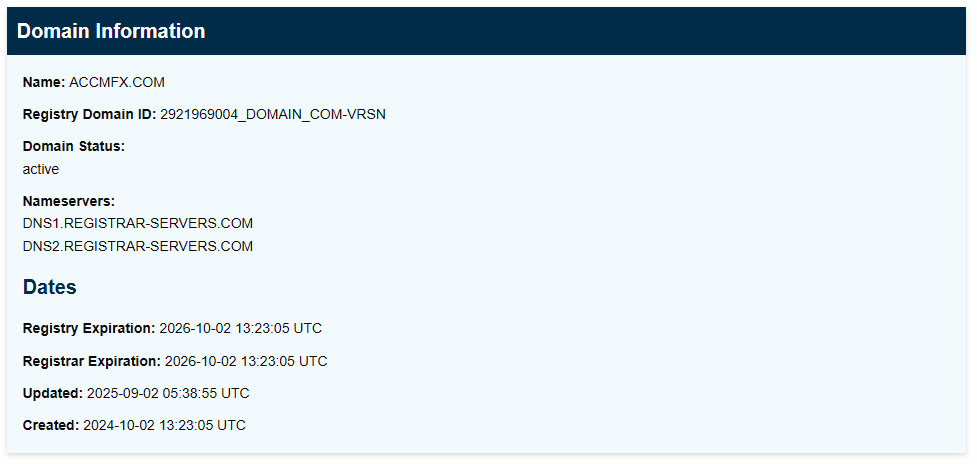
The 2007 date the marketing leans on belongs to a different domain entirely — accapital.com, the historical AC Capital Market website. We tried to reach it during this review, and the site no longer functions as a working client portal. In other words, the broker has walked away from the very domains that supported its 19-year claim, and migrated everything to a freshly registered website that has no operational history of its own.
Combined with a brand-new MotoGP sponsorship announced in February 2026, a fresh South African subsidiary incorporated in 2024 (ACCM ZA Pty Ltd, reg. No. 2024/043767/07), an emphasized Vanuatu issuer, and the abandonment of the legacy domains that actually held the brand’s history, we read this as a textbook offshore rebrand: the corporate group is real, but the customer-facing website is barely a year old and conveniently inherits all the legend of its predecessors while shedding any complaints, search-engine reputation, or WHOIS history attached to them. A 12-month-old domain trading on a 19-year-old story is not the same thing as a 19-year-old broker. That distinction matters when the entry ticket is a $500 deposit.
Due Diligence: Onboarding & Funding
We registered an account on accmfx.com to test the funnel firsthand, and the very first screen tells us a lot about who this onboarding flow is built for. The default phone-number country code is +86 (China), the form includes an optional “Invitation code” field, and although email is verified once during signup via a one-time confirmation code, there is no two-factor authentication of any kind afterwards — no SMS challenge, no authenticator app, no login-time email check.
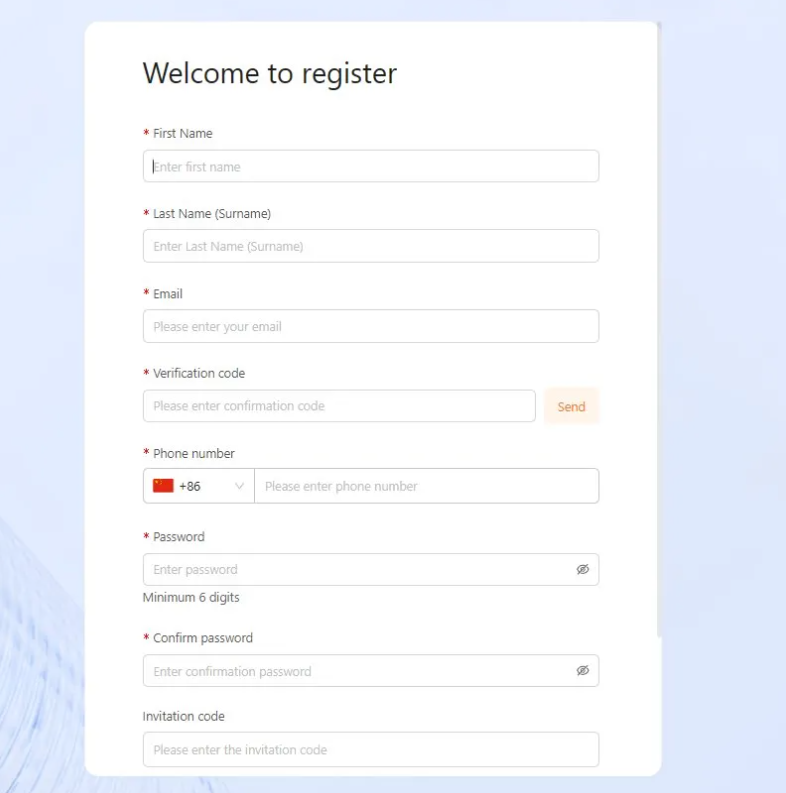
The verification logic follows the offshore CFD playbook almost to the letter. After signup, the dashboard greets the user with a “Please complete your account information” popup and a sidebar promoting a “100% Deposit Bonus” — a marketing instrument ESMA, FCA, and ASIC have outright banned for retail clients precisely because of the withdrawal disputes it generates.
Payment options listed across public sources include Skrill, Neteller, Wire Transfer, WebPay, Kakao, FastPay, Paystack, and Paytm — a fragmented mix dominated by regional Asia-Pacific processors rather than the standard Visa/Mastercard/SEPA rails a regulated EU broker would use.
ACCM Conditions and Manipulations
The company advertises “Direct Market Access” with an aggregation of “top-tier banks and liquidity providers”, yet not a single LP, prime broker, or banking partner is named anywhere on the website. This is the core inconsistency in offshore CFD setups: real ECN/STP routing requires named providers, and their absence usually means the execution model is actually 100% B-Book or market-maker — where the broker takes the opposite side of every trade and books client losses as house revenue.
Combined with leverage of up to 1:800 (impossible under any Tier-1 regulator — ESMA, ASIC, and the FCA all cap retail FX at 1:30), zero commission on the Standard account, and “variable spreads” with no published typical-spread sheet, the setup is the textbook offshore B-Book: the broker profits when the client loses, and higher leverage accelerates that conversion.
Accmfx.com Withdrawal Integrity & Exit Process
The “100% Deposit Bonus” advertised on the dashboard is not the gift it appears to be — these bonuses are universally tied to heavy volume requirements, and any withdrawal attempted before the threshold is hit triggers automatic forfeiture of both the bonus and proportional profits. ESMA, the FCA, and ASIC have outright banned deposit bonuses for retail clients precisely because they convert a generous-looking incentive into a contractual lock on the client’s own capital.
Strengths & Weaknesses Analysis
-
Real corporate footprint with verifiable licenses.
-
Demo account.
-
The retail-facing entity is regulated only by the VFSC (Vanuatu).
-
Domain age contradicts marketing legend.
-
No named liquidity providers, prime brokers, or banking partners.
-
"100% Deposit Bonus" promotion.
-
A high minimum deposit.
Investment Risk Summary
After completing this accmfx.com review, our position is straightforward: the broker is licensed where it operates, but licensed is not the same as safe. The retail counterparty sits in Vanuatu under a Tier-3 regulator, the ASIC badge belongs to a separate entity that doesn’t service clients of the website, and the 19-year heritage points to a domain that is no longer the active client portal. The setup is not fraudulent — it is simply engineered so that every structural advantage sits with the broker, not with you.



Opened a Standard account with ACCM in late 2025, deposited $2,000, traded gold and EURUSD for about six weeks. Strategy was nothing exotic — swing trades held for 1–3 days, no scalping, no EAs, no arbitrage. The account grew to roughly $3,400. The moment I requested a withdrawal of $1,500, the platform froze my account “pending review” and a week later I received an email saying my activity was flagged as “abusive trading patterns”. No specifics, no trade IDs, no breakdown — just a generic notice. They eventually returned my $2,000 principal but voided every dollar of profit. When I asked for the exact rule I had supposedly violated, support went silent for three weeks. Lesson learned: do not deposit anything into a Vanuatu broker that you cannot afford to lose to an “abusive trading” clause.
Trading EURUSD works fine in flat markets, but the moment any high-impact news drops the spread jumps from 1.5 pips to 30+ and stop-losses get triggered at prices I never actually saw on the chart. Asked support for an execution log and got a generic “market volatility” reply with no tick data. This is not Tier-1 broker behaviour, it’s classic 100% B-Book server-side manipulation during news events!